
What Is Generative Engine Optimization? A Plain-English Guide for 2026
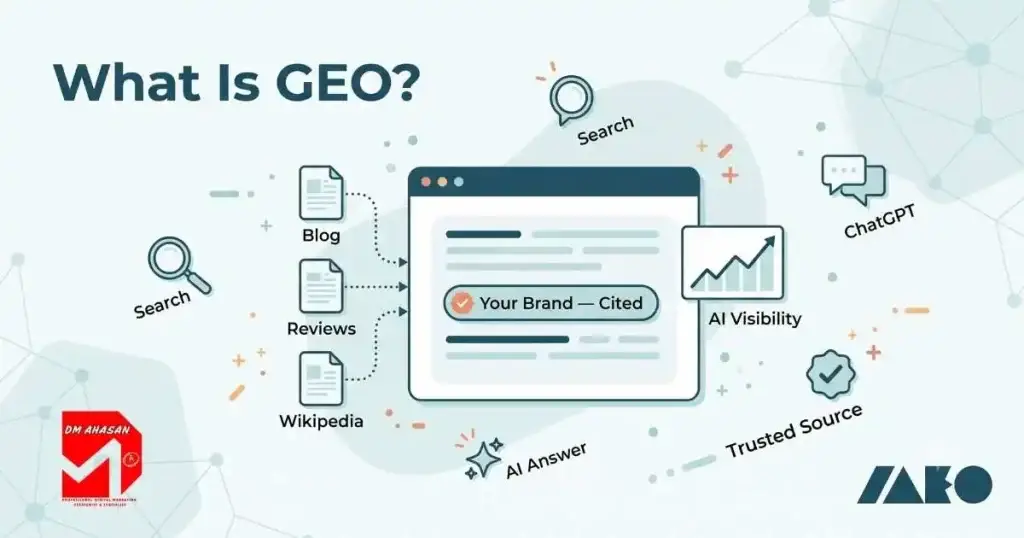
What is generative engine optimization? In one sentence: it’s the practice of structuring your content and brand presence so AI tools like ChatGPT, Perplexity, Gemini, and Google’s AI Overviews actually cite you when they answer people’s questions — instead of citing your competitor while you sit there ranking politely on page one, wondering where everyone went.
If that sentence made you slightly uncomfortable, good. It should. Because a growing share of your potential customers now get their answers from an AI assistant without ever seeing a search results page. This guide breaks down what GEO actually is, how it differs from the SEO you already know, and exactly what to do about it — in plain English, no PhD required.
Table of Contents
What Is Generative Engine Optimization, Exactly?
Generative Engine Optimization (GEO) is the process of optimizing your content so that AI-powered systems can understand it, extract it, and cite it when generating answers. The term isn’t marketing fluff, either — it comes from a 2024 research paper by researchers at Princeton and IIT Delhi, who formally defined GEO and tested which tactics actually influence whether AI engines reference a source.
Their most useful finding: content tweaks like adding relevant statistics, quoting credible sources, and improving fluency boosted a source’s visibility in AI-generated answers by roughly 15–40%. In other words, this isn’t astrology. It’s measurable, and the levers are surprisingly ordinary.
You’ll also see GEO travel under aliases: AEO (Answer Engine Optimization), LLMO (Large Language Model Optimization), even ‘AI SEO.’ Different acronyms, same job — the industry just hasn’t finished arguing about what to call it yet. Marketers love a good acronym fight almost as much as they love a dashboard.
Why Should You Care in 2026? (The Numbers Are Loud)
Here’s the short version of why GEO went from conference buzzword to budget line item:
- AI-referred traffic jumped 527% year-over-year in the first five months of 2025, according to Previsible’s AI Traffic Report — and it hasn’t slowed down since.
- ChatGPT alone sees around 3.8 billion visits per month, and Perplexity processes hundreds of millions of queries monthly. These aren’t people abandoning Google — they’re adding a second search habit.
- Ranking #1 on Google no longer guarantees a citation. Studies tracking AI answers keep finding that the pages AI tools cite overlap less and less with the traditional top 10.
- Google AI Mode is now live in 200+ countries. The AI answer layer isn’t an American experiment anymore — it’s the default surface your customers see, from New York to Dhaka.
Put simply: the research phase of buying — the part where your customer decides who seems credible — is increasingly happening inside an AI answer box. If you’re not in the answer, you’re not in the running. (I covered the strategic side of this shift in my SEO vs GEO comparison — worth reading next if you haven’t.)
GEO vs SEO vs AEO: A Side-by-Side Comparison
| SEO | AEO | GEO | |
| Goal | Rank in a list of links | Be the featured/direct answer | Be cited inside AI-generated responses |
| Where it plays out | Google & Bing results pages | Featured snippets, voice assistants | ChatGPT, Perplexity, Gemini, AI Overviews |
| Success metric | Rankings, clicks, organic traffic | Snippet ownership, position zero | Citations, brand mentions, share of AI answers |
| Core levers | Keywords, backlinks, technical health | Question-based structure, schema | Clarity, statistics, entity consistency, off-site mentions |
| Relationship | The foundation | A specialization of SEO | Extends SEO — doesn’t replace it |
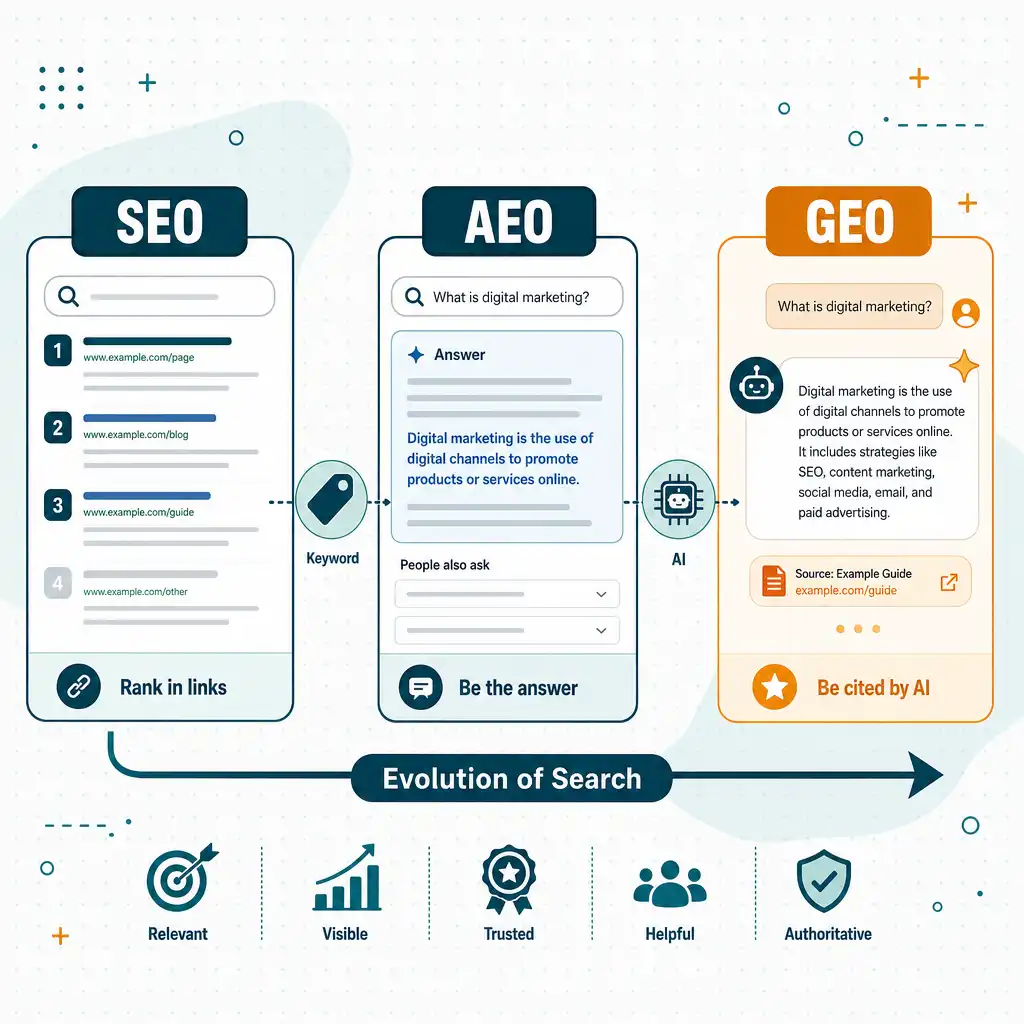
The key takeaway from this table: GEO doesn’t replace SEO. Google’s own documentation essentially says GEO is SEO — the fundamentals of quality content, crawlability, and authority still power everything. Think of SEO as the foundation of the house and GEO as making sure the house shows up on the new map everyone’s suddenly using.
How Do Generative Engines Actually Pick Their Sources?
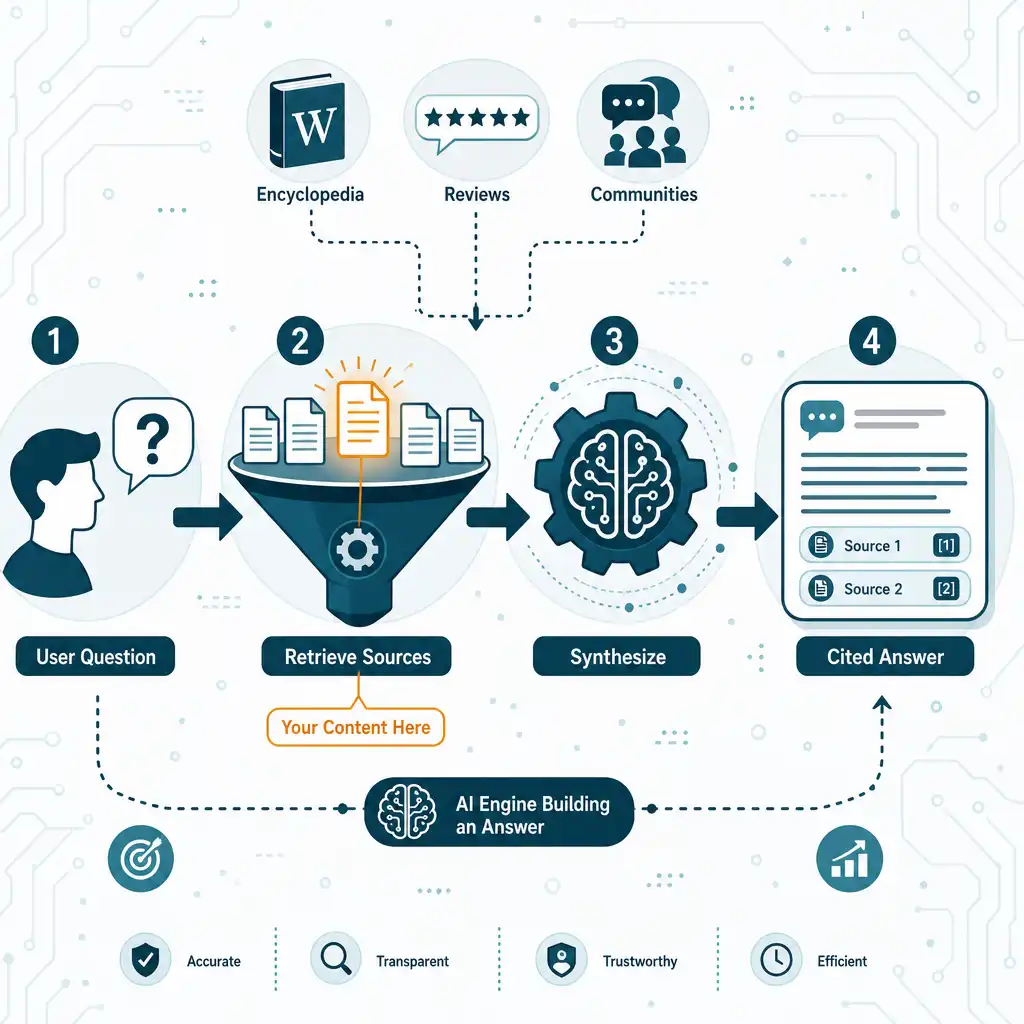
Understanding this makes everything else click. When someone asks an AI tool a question, most modern systems do a version of the following: interpret the question, retrieve a handful of relevant sources from the live web, and then synthesize an answer grounded in those sources — citing some of them along the way.
Notice the bottleneck: only a handful of sources get retrieved per query. That’s the entire game. GEO is the competition to be inside that handful. And AI systems don’t only look at your website — they lean heavily on third-party surfaces they trust. Research on ChatGPT’s citation patterns found Wikipedia alone accounts for nearly half of its top-cited sources for factual questions, with platforms like Reddit, YouTube, G2, and LinkedIn also pulling serious weight.
Translation: your GEO footprint is your whole web presence, not just your domain. If your brand only exists on your own website, an AI model has nothing to cross-reference — and models, like people, trust claims more when someone else makes them about you.
The signals that consistently matter
- Clarity and direct answers — AI extracts the clearest statement on the page. Give it one worth extracting, right under each heading.
- Statistics and cited sources — the Princeton research found data-backed content earns measurably more AI visibility. Numbers are candy for language models.
- Entity consistency — your brand name, what you do, and who you serve should be described the same way everywhere. Confuse the model, lose the citation.
- Fresh, dated content — a visible ‘last updated’ date is a cheap, powerful trust signal.
- Off-site mentions — reviews, guest articles, interviews, directories. Unlinked brand mentions now do work that only backlinks used to do.
- Technical access — if your robots.txt blocks GPTBot, PerplexityBot, or ClaudeBot, you’ve opted out of the entire channel without noticing. (Yes, this happens constantly. Check yours today — it’s covered in my Core Web Vitals checklist alongside the other technical hygiene items.)
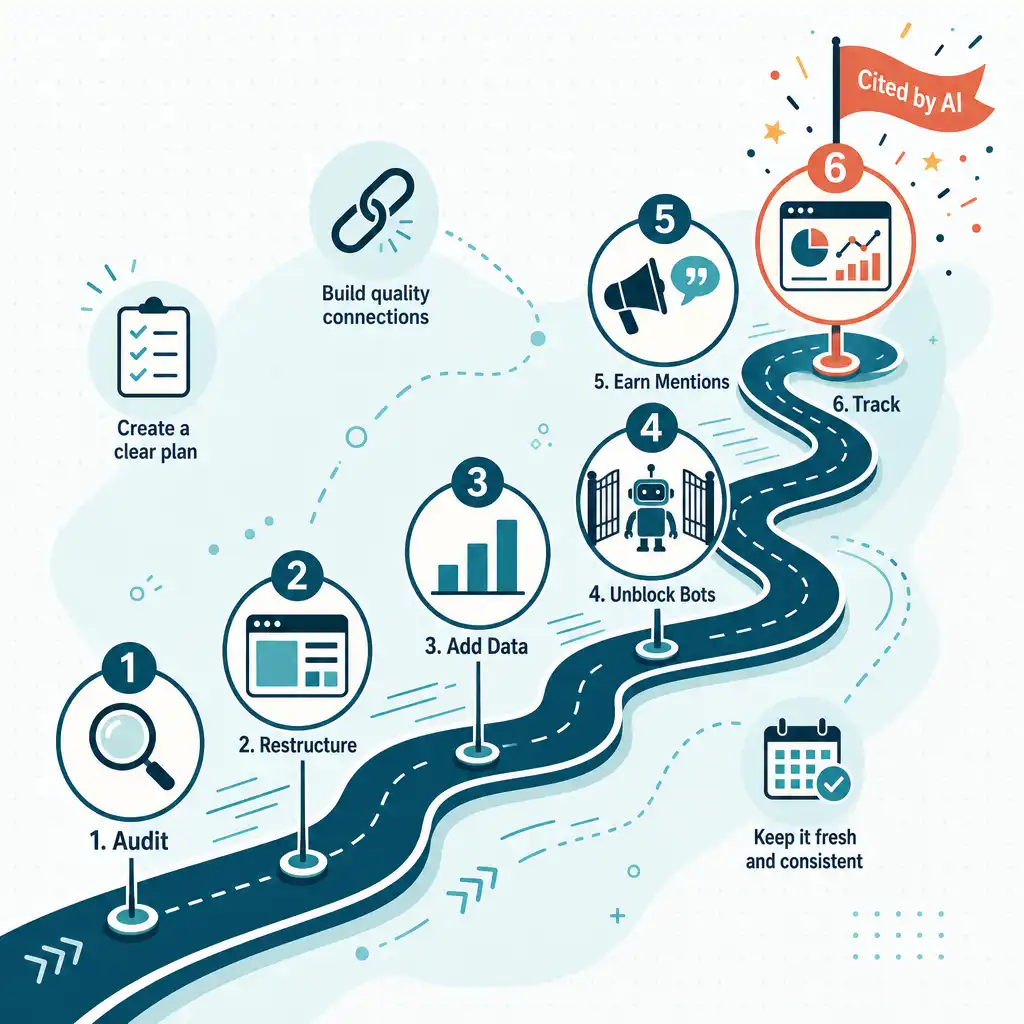
How to Start With GEO: A 6-Step Starter Plan
1. Audit your AI visibility manually. Ask ChatGPT, Perplexity, and Gemini the questions your customers actually ask. Note who gets cited. If it’s not you, you now have both a problem statement and a competitor list — efficient!
2. Restructure your key pages for extraction. Open every important section with a one-to-two line direct answer, then elaborate. Add comparison tables and clearly defined terms. This is the single highest-leverage change most sites can make this week.
3. Add statistics and sources to your cornerstone content. Back claims with real numbers and link the sources. It builds trust with humans and, per the research, measurably increases your odds of being cited by machines.
4. Unblock the AI crawlers. Review robots.txt for GPTBot, PerplexityBot, ClaudeBot, and friends. Make sure critical content isn’t hidden behind JavaScript rendering or logins.
5. Build your off-site footprint. Pursue mentions on credible industry sites, review platforms, and relevant communities. One genuine expert quote in a respected publication can outwork ten thin blog posts.
6. Track monthly, adjust quarterly. GEO tooling is young, but even a simple spreadsheet of ‘questions asked → brands cited’ tracked monthly will show you movement. What gets measured gets cited. Eventually.
Common GEO Mistakes to Avoid
- Treating GEO as a replacement for SEO — it’s an extension. Abandoning fundamentals to chase AI citations is trading your foundation for a weathervane.
- Publishing AI-generated filler at scale — generative engines are getting noticeably better at ignoring content that reads like it was produced by their cousin.
- Optimizing only your own domain — ignoring Wikipedia, Reddit, review sites, and industry publications means ignoring where AI models actually look.
- Vague, jargon-heavy writing — if a human needs to read your paragraph twice, an AI model will simply pick someone clearer. Fluency isn’t decoration; it’s a ranking factor now.
- Expecting overnight results — citation patterns shift over weeks and months, not days. GEO rewards the patient, which is deeply unfair to marketers as a species.
The Bottom Line
So, what is generative engine optimization when you strip away the acronyms? It’s simply this: make your content so clear, credible, and well-evidenced that when an AI assembles an answer, leaving you out feels like a mistake. The tactics — direct answers, real statistics, consistent entity signals, off-site credibility, open crawler access — are things good marketers should arguably have been doing anyway. AI search just turned ‘nice to have’ into ‘non-negotiable.’
Start with the six-step plan above, be consistent, and give it a quarter. And if you’d rather have someone who’s been living in this shift build the system with you, that’s exactly what I do — let’s talk about where your brand stands in the AI answer layer today.
Frequently Asked Questions
What is generative engine optimization in simple terms?
It’s the practice of structuring your content and online presence so AI tools like ChatGPT, Perplexity, and Google’s AI Overviews cite your brand when answering user questions — being part of the answer rather than just a link below it.
Is GEO the same as SEO?
No, but they’re closely related. SEO optimizes for ranking in search results; GEO optimizes for being cited inside AI-generated answers. GEO builds on SEO fundamentals rather than replacing them — Google itself treats GEO as part of SEO.
What’s the difference between GEO and AEO?
In practice, very little — most practitioners use the terms interchangeably. AEO (Answer Engine Optimization) emphasizes being the direct answer to a question; GEO is the broader umbrella covering visibility across all AI-generated responses.
How long does GEO take to show results?
A well-structured page can start appearing in AI answers within weeks, but consistent, brand-level visibility typically takes a few months of steady content and off-site credibility work. Track monthly and judge quarterly.
Do I need special tools for generative engine optimization?
Not to start. Manually querying ChatGPT, Perplexity, and Gemini with your customers’ real questions is a perfectly good audit. Dedicated GEO tracking tools exist and are maturing fast, but a disciplined spreadsheet beats an ignored dashboard.
Does GEO work for small businesses, or only big brands?
It works for small businesses — arguably better right now, because competitive density is still low in most niches. A small brand with exceptionally clear, well-evidenced content can out-cite a larger competitor whose pages are vague. That window won’t stay open forever.