Brand Mentions SEO: The Best-Kept Secret of AI-Era Rankings
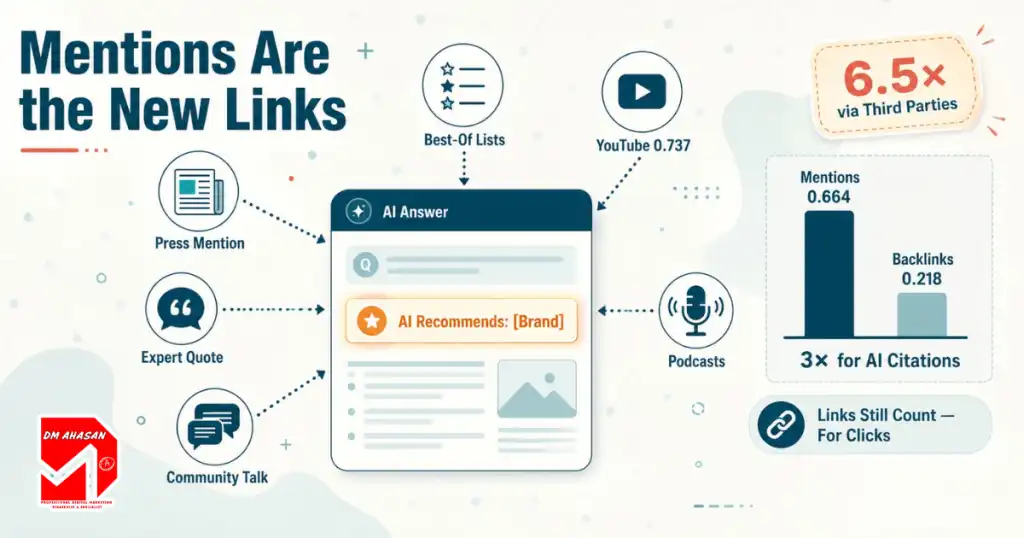
Brand mentions SEO is the discipline of earning references to your brand across the web — linked or not — and in 2026 the data behind it is startling: an Ahrefs study of 75,000 brands found unlinked web mentions correlate with AI citations at 0.664, while backlinks correlate at just 0.218. That’s a roughly 3× gap in favor of plain-text mentions — the references SEO teams spent two decades treating as consolation prizes. Ahrefs’ own CMO now calls citations ‘the new backlinks,’ and the marginal marketing dollar quietly moved from link placements to earned conversations.
This guide explains why mentions suddenly matter this much, the numbers that should reshape your PR budget, how AI engines actually read your brand, and a practical playbook for building mention-driven visibility — including the reclamation workflow that converts existing mentions into links for a double win.
Table of Contents
Brand Mentions SEO: Why Plain Text Beats Links in the AI Era
Traditional SEO ran on a link graph: hyperlinks passed authority, and mentions without links passed approximately nothing. AI search broke that model, because language models don’t count links — they read text and build entity understanding. When your brand name appears repeatedly across trusted publications, forums, reviews, and videos, the model learns what you are, what you’re good at, and whether independent sources agree. Consensus across sources is precisely what an answer engine looks for when deciding which brands to name.
The evidence stack, in brief:
- The 3× correlation: unlinked mentions 0.664 vs backlinks 0.218 for AI citations (Ahrefs, 75,000 brands). YouTube mentions scored even higher at 0.737 — the conversation about you matters more than the anchors pointing at you.
- Third-party gravity: brands are 6.5× more likely to be cited by AI through third-party sources than through their own domains (AirOps, 21,311 mentions across ChatGPT, Claude, and Perplexity). Your website alone cannot make your case.
- The ranking decoupling: nearly 90% of pages cited by ChatGPT rank position 21 or lower in Google. AI engines aren’t reading the leaderboard; they’re reading the room.
- The old-school receipt: Google’s own 2012 ‘Ranking Search Results’ patent describes ‘implied links’ — unlinked references counted alongside express links. Mentions were never worthless; they were early.
What Counts as a Mention (And What Counts Double)
| Mention Type | Example | Why It Works |
| Editorial press | An industry publication names you in a trend piece | High-trust source; strongest entity signal |
| Expert quotes | Your founder quoted in an article or report | Ties a person-entity to your brand-entity — E-E-A-T fuel |
| Community talk | Reddit threads, forums, niche Slack/Discord groups | AI engines lean heavily on community consensus |
| Reviews & comparisons | Third-party ‘best X tools’ lists and review platforms | Directly feeds ‘which brand should I use’ answers |
| Podcasts & YouTube | Guest appearances, tool walkthroughs, mentions in videos | YouTube mentions showed the highest citation correlation (0.737) |
| Directories & events | Association listings, conference agendas, government/edu citations | Hard-to-fake credibility signals |
The pattern across all six: independence. A hundred mentions on your own blog teach the model nothing; ten mentions across sources you don’t control teach it consensus. This is also why mention-building resists shortcuts — it’s genuinely hard to fake at scale, which is exactly why it’s becoming the moat.
The Mention-Building Playbook (6 Moves)
1. Become quotable on purpose. Publish original data, run small surveys, take clear positions. Journalists and bloggers cite sources that hand them a number or a crisp opinion — ‘according to a study by [you]’ is the highest-value sentence in digital PR.
2. Work the expert-quote circuit. Respond to journalist request platforms, offer commentary on industry news within hours of it breaking, and make your founder findable and fast. One quote in a respected outlet outworks ten guest posts nobody reads.
3. Show up in communities as a human. Genuine participation in Reddit, forums, and niche groups builds the exact mention layer AI engines weigh — but the community smells promotion instantly. Contribute 10:1 before your brand ever comes up, and let others name you where possible.
4. Court reviews and listicles deliberately. Identify the ‘best [your category]’ articles AI engines cite for your money questions (just ask the engines and see who they name), then earn your way into those specific pieces — via the author, genuine product access, or being objectively worth including.
5. Keep your entity story consistent everywhere. Same brand name, same one-line description, same positioning across your site, profiles, directories, and bios. Models triangulate; contradictions dilute. This is the off-site half of generative engine optimization — the on-site half is covered in my GEO guide.
6. Run the reclamation workflow for double value. Find existing unlinked mentions (content-explorer tools surface them), then politely ask editors to add a link. Timing matters: the 1–14 day window after publication converts best, and well-qualified, personalized asks convert at 15–40%. The mention already helps your AI visibility; the added link stacks traditional SEO value on top. Also note: tier-1 outlets rarely respond to cold link pitches at all — converting an existing mention is often the only realistic way in.
How to Measure Mention-Driven Visibility
- Mention tracking: monitor your brand name (and product names, and founder name) across the web with media-monitoring or SEO tools — volume, source quality, and sentiment over time.
- AI citation share: regularly ask ChatGPT, Perplexity, and Google’s AI Overviews your category’s money questions and log which brands get named. Your share of those answers is the new share of voice — and it pairs with the zero-click reality where the answer, not the click, is the battleground.
- Branded search volume: rising searches for your name are the lagging indicator that the conversation is working.
- Referral quality: mentions drive fewer clicks than links but warmer ones — track conversion rate of the traffic that does arrive.
The Bottom Line
Brand mentions SEO is the best-kept secret precisely because it looks like PR and measures like search: plain-text references across independent, trusted sources now correlate with AI citations three times more strongly than backlinks, and the brands AI engines recommend are the ones the wider web keeps talking about. Links still matter — they carry clicks and classic authority — but the marginal dollar now buys more visibility in earned conversations than in anchor text. Build quotability, work the communities, keep your entity story consistent, and reclaim what you’ve already earned.
If you’d like a mention-driven visibility strategy — the digital PR, the AI citation tracking, and the content that makes your brand the one engines name — that’s exactly the work I do. Let’s find out who AI recommends in your category today, and change the answer.
Brand mentions are one signal among many — pairing them with your own first-party data strategy gives a fuller picture of what’s actually driving growth.
Frequently Asked Questions
What are brand mentions in SEO?
Any reference to your brand, product, or key people in online content — with or without a hyperlink. Linked mentions pass traditional SEO authority and traffic; unlinked mentions build the entity recognition and consensus signals that AI search engines use when deciding which brands to cite and recommend.
Do unlinked brand mentions help SEO?
For AI visibility, clearly yes — Ahrefs’ 75,000-brand study found unlinked mentions correlate with AI citations at 0.664 versus 0.218 for backlinks. For traditional Google rankings, Google’s ‘implied links’ patent suggests mentions play a role, though Google hasn’t publicly confirmed direct ranking impact.
Are brand mentions better than backlinks?
They’re complementary, not competing: backlinks still drive referral traffic and classic link authority; mentions build the semantic associations answer engines rely on. The 2026 shift is budgetary — earned conversations now buy more AI visibility per dollar than purchased link placements.
How do AI engines like ChatGPT decide which brands to cite?
Primarily through mention frequency, source quality, sentiment, and consistency across independent sources — consensus. Notably, nearly 90% of ChatGPT-cited pages rank position 21+ in Google, and brands are 6.5× more likely to be cited via third-party sources than their own sites — so the conversation about you outweighs both your rankings and your own content.
How do I find my unlinked brand mentions?
Use content-discovery tools (Ahrefs Content Explorer and similar) or media-monitoring platforms to search your brand name, excluding your own domain and pages that already link. Then run reclamation outreach: personalized requests in the 1–14 days after publication convert at 15–40% for well-matched mentions.
How long does a brand-mention strategy take to work?
Expect compounding over months, not days: AI models refresh their picture of the web on rolling cycles, and consensus builds mention by mention. Most brands see measurable AI-citation movement within one to two quarters of consistent digital PR, community presence, and review coverage.