What Is Supply Chain Management? A Beginner-Friendly 2026 Guide
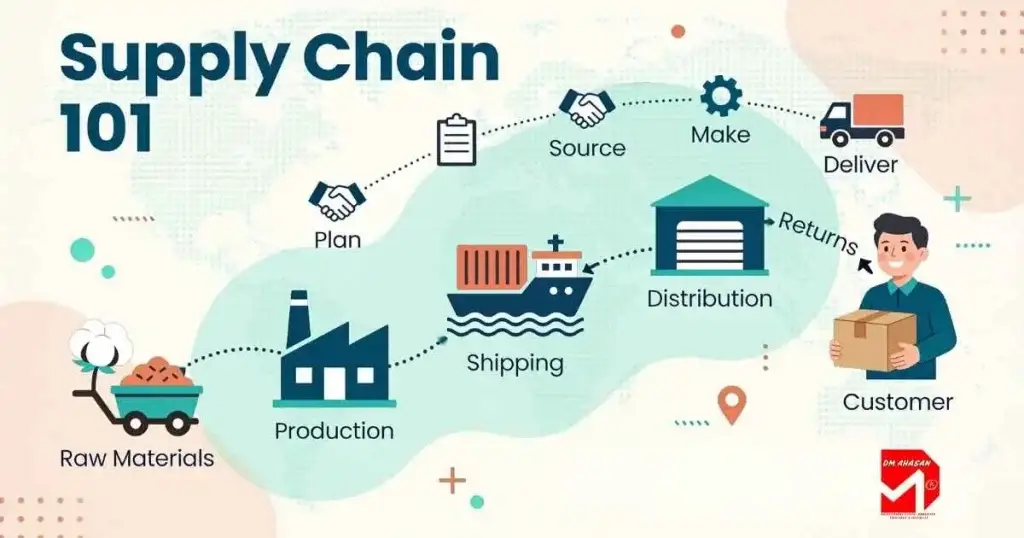
What is supply chain management? In the simplest terms, it’s the coordination of everything required to turn raw materials into a finished product in a customer’s hands — planning, sourcing, manufacturing, delivery, and returns — done in a way that’s fast, cost-effective, and doesn’t collapse the moment a ship gets stuck sideways in a canal. (Yes, that actually happened. The internet has never fully recovered.)
Whether you’re a student, a new e-commerce seller, or a business owner who just realized ‘logistics’ and ‘supply chain’ aren’t the same word, this guide walks you through the whole picture in plain English: what supply chain management actually covers, the five stages every product goes through, why it suddenly became everyone’s favorite dinner-table topic, and the terms you’ll keep running into.
Table of Contents
What Is Supply Chain Management? The Plain-English Definition
Supply chain management (SCM) is the discipline of overseeing the entire flow of goods, information, and money — from the first raw material a supplier digs up, grows, or molds, all the way to the finished product a customer unboxes, and even back again when they return it.
Notice the three flows in that definition, because they’re the heart of the whole field:
- Goods — the physical stuff moving from suppliers to factories to warehouses to customers.
- Information — orders, forecasts, tracking data, and inventory levels flowing in every direction. Bad information ruins good logistics faster than bad weather.
- Money — payments, credit terms, and costs flowing upstream while products flow downstream.
A supply chain, then, is the network of companies, people, activities, and resources involved in that flow. Supply chain management is the art of making that network run on purpose rather than by accident. Most companies, if we’re honest, start with the ‘by accident’ version and upgrade only after something expensive happens.
The 5 Stages of Supply Chain Management
The industry-standard way to break down SCM comes from the SCOR model (Supply Chain Operations Reference), and it maps every supply chain — from a two-person Amazon FBA business to Toyota — onto five stages:
| Stage | What Happens Here | What Goes Wrong Without It |
| 1. Plan | Forecast demand, set inventory targets, budget capacity | You produce 10,000 units of what nobody wants — or 100 of what everybody does |
| 2. Source | Find, vet, and negotiate with suppliers of materials and goods | One supplier hiccup and your entire product line goes on unplanned vacation |
| 3. Make | Manufacture, assemble, test, and package the product | Quality issues, production delays, and costs that eat your margin alive |
| 4. Deliver | Warehousing, order management, transportation, last-mile delivery | The product exists — but it’s in the wrong country, warehouse, or century |
| 5. Return | Handle returns, repairs, recycling, and reverse logistics | Returns pile up as pure cost instead of recovered value and customer trust |
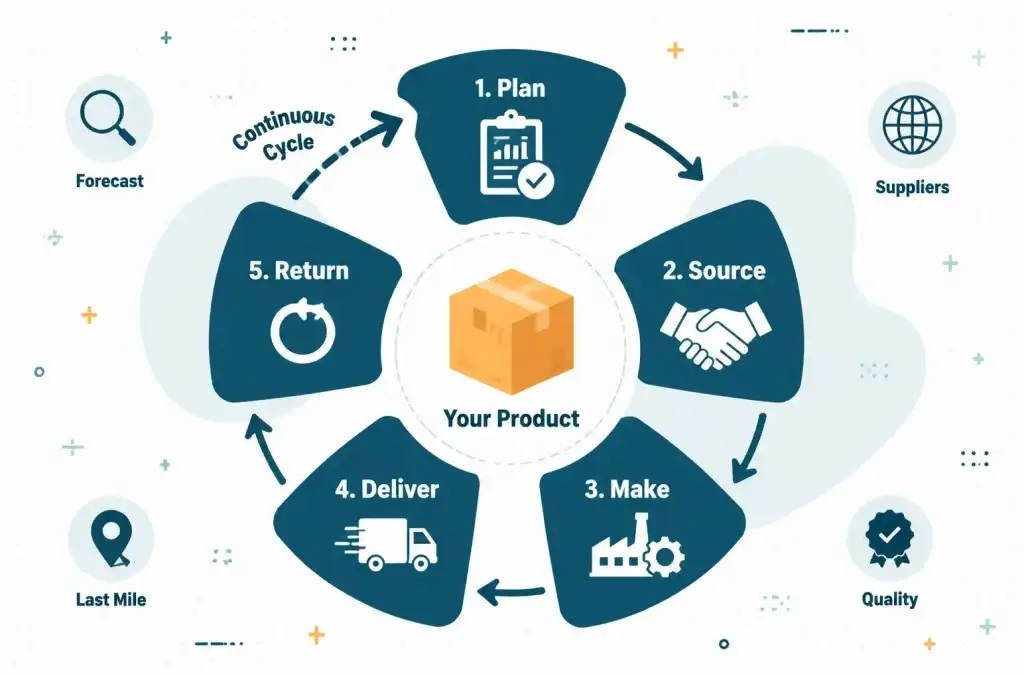
If you sell on Amazon, you’ve already lived all five of these — possibly in one very stressful week. Planning is your inventory forecast, sourcing is your supplier hunt, making is production and prep (which, since Amazon FBA prep services ended in January 2026, is now entirely your responsibility), delivery is inbound freight plus Amazon’s fulfillment, and returns are… well, returns. Nobody escapes stage five.
Supply Chain vs Logistics: What’s the Difference?
This mix-up is so common it deserves its own section. Short answer: logistics is a part of supply chain management, not a synonym for it.
| Supply Chain Management | Logistics | |
| Scope | The entire journey — raw material to customer and back | One piece of that journey — moving and storing goods |
| Focus | Strategy: supplier networks, production, demand, risk | Execution: transportation, warehousing, delivery |
| Question it answers | “How should our product get made and reach customers profitably?” | “How does this box get from point A to point B efficiently?” |
| Relationship | The whole orchestra | A key instrument in it |
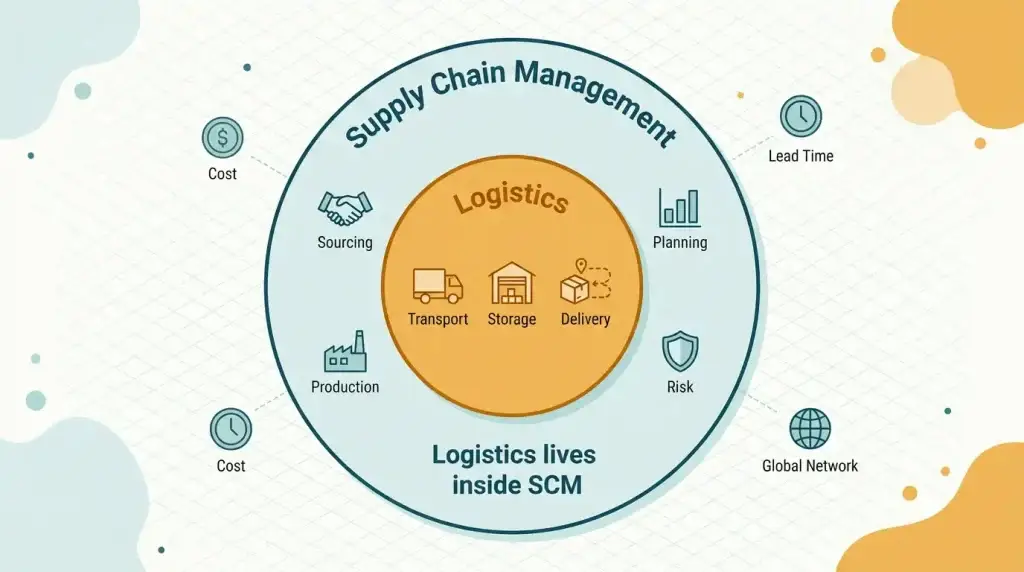
So when someone says ‘we have a logistics problem,’ they usually mean a truck, a warehouse, or a delivery is misbehaving. When they say ‘we have a supply chain problem,’ the issue could be anywhere from a supplier’s factory in another hemisphere to a demand forecast someone built on vibes.
Why Supply Chain Management Matters More Than Ever in 2026
For decades, supply chains were the business equivalent of plumbing — vital, invisible, and discussed by absolutely no one at parties. Then 2020-2024 happened, and suddenly everyone’s uncle had opinions about container shipping. The numbers explain why it stayed on the agenda:
- The global logistics market reached $11.23 trillion in 2025 — with e-commerce logistics alone at roughly $650 billion. This is not a niche; it’s one of the largest cost centers in the world economy.
- 80% of organizations experienced at least one supply chain disruption in 2024, and disruptions are estimated to cost businesses around $184 billion annually. ‘It probably won’t happen to us’ is no longer a strategy — it’s a countdown.
- Tariffs and trade shifts are reshaping sourcing decisions in real time — 73% of supply chain leaders expect to hit their ‘tariff absorption wall’ by the end of 2026, the point where margins can no longer quietly eat the added costs.
- 64% of companies are actively regionalizing their supply chains, and the old ‘Just in Time’ philosophy has visibly evolved into ‘Just in Case’ — holding more buffer stock, closer to customers, from more diverse suppliers.
- AI has entered the warehouse: the AI-in-supply-chain market is projected to grow from around $640 million in 2024 to $27.4 billion by 2034, and AI-enabled supply chains already report significantly higher service levels. The robots are not coming for the supply chain — they’re already in it, scanning barcodes.
The strategic takeaway: supply chain management graduated from back-office function to boardroom topic. Companies now win or lose markets based on how resilient, fast, and adaptable their chains are — which is exactly why diversifying away from single-country sourcing has become the default playbook rather than the paranoid option.
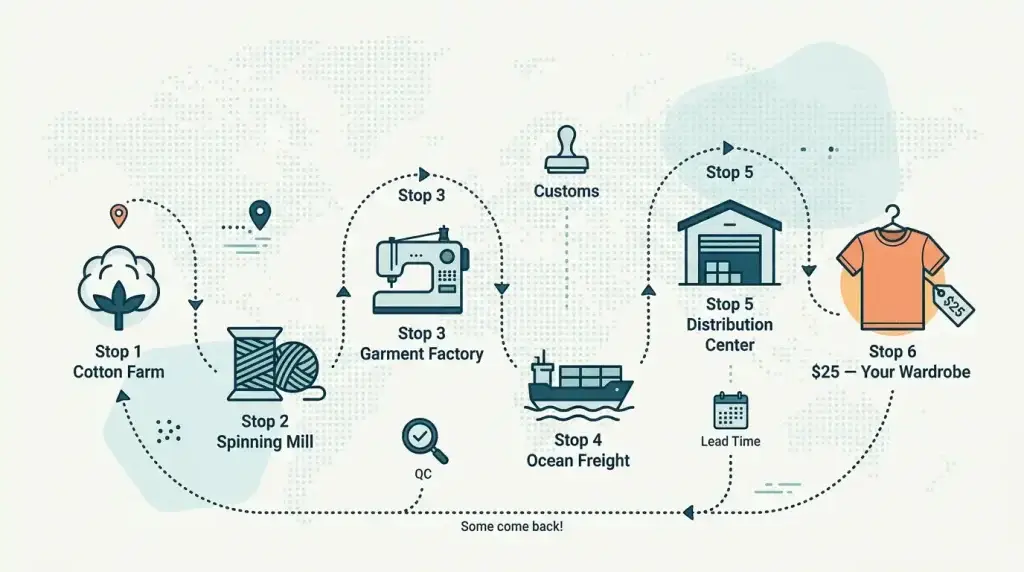
A Real-World Example: The Life of a T-Shirt
Abstract definitions are fine, but supply chains make more sense when you follow one product. Meet a $25 t-shirt:
Plan: A brand forecasts it will sell 50,000 units of this design this year, based on last year’s sales, trend data, and a hopeful spreadsheet.
Source: Cotton is grown and ginned in one country, spun into yarn in another, and knitted into fabric in a third. The brand’s sourcing team negotiates prices, lead times, and quality standards — increasingly across multiple countries so one border dispute can’t strand the whole line.
Make: A garment factory cuts, sews, prints, and packs the shirts. Quality control checks a sample of every batch, because one bad print run multiplied by 50,000 is a very memorable meeting.
Deliver: Finished shirts move by container ship (governed by trade terms like FOB or CIF — that’s a whole topic of its own), clear customs, land in a distribution center, and flow to retail stores or straight to your door.
Return: Some shirts come back — wrong size, changed mind, mysterious reasons known only to the customer. Reverse logistics decides what gets restocked, refurbished, donated, or recycled.
Every stage involves different companies, contracts, currencies, and risks — and supply chain management is the job of making all of it look, from the outside, like you simply ordered a t-shirt and it appeared.
Key Supply Chain Terms You’ll Keep Running Into
Procurement: The process of finding and buying the goods and services a company needs. Sourcing’s more formal cousin.
3PL (Third-Party Logistics): An outside company that handles warehousing, fulfillment, or shipping on your behalf — a topic big enough that I’ve given it its own guide in this series.
Lead time: How long it takes from placing an order to receiving it. The number every planner underestimates exactly once.
Safety stock: Extra inventory held as a buffer against demand spikes or supply delays. Insurance you can stack on a shelf.
Nearshoring / Reshoring: Moving production closer to (or back into) your home market to cut lead times and geopolitical risk.
Visibility: Knowing where your inventory actually is at any moment — surprisingly rare, enormously valuable.
Reverse logistics: Everything involved in moving products backward: returns, repairs, recycling, disposal.
The Bottom Line
So, what is supply chain management when you strip away the jargon? It’s the discipline of making sure the right product exists, in the right quantity, in the right place, at the right time, at a cost that leaves you a business worth running — across a world that keeps throwing tariffs, storms, and sideways ships at you.
Master the five stages — plan, source, make, deliver, return — and you have the mental model behind every product you’ve ever bought. This guide is the foundation; from here, the deeper topics (diversified sourcing, 3PLs, inventory formulas, trade terms, exporting) each get their own dedicated guide on this blog. And if you’re building an e-commerce or import business and want experienced eyes on your chain — from sourcing strategy to the marketing that sells what arrives — that’s exactly what I help businesses do. Let’s talk.
Frequently Asked Questions
What is supply chain management in simple words?
It’s managing everything needed to get a product from raw materials to the customer — planning, buying materials, manufacturing, delivering, and handling returns — as efficiently and reliably as possible.
What are the 5 stages of supply chain management?
Plan, Source, Make, Deliver, and Return — the framework from the industry-standard SCOR model. Planning forecasts demand, sourcing secures suppliers, making produces goods, delivering gets them to customers, and returns handles the reverse flow.
What is the difference between supply chain management and logistics?
Logistics is one component of supply chain management — the movement and storage of goods. SCM covers the full strategic picture: supplier relationships, production, demand planning, risk management, and logistics itself.
Why is supply chain management important for small businesses?
Because small businesses feel disruptions hardest — one delayed shipment or supplier failure can wipe out a month of sales. Good SCM basics (buffer stock, backup suppliers, realistic lead times) are survival tools, not corporate luxuries.
Is supply chain management a good career in 2026?
Yes — demand for supply chain professionals keeps growing as companies invest in resilience, AI-driven planning, and regionalized networks. It’s a field where analytical skills and practical problem-solving both pay, and where the interesting problems show no sign of running out.
What skills do you need for supply chain management?
Core skills include data analysis, negotiation, demand forecasting, and project management — increasingly paired with comfort using AI-powered planning and visibility tools. Soft skills matter too: much of SCM is coordinating people who have never met and don’t share a time zone.
Supply Chain Management in simple language by Educationleaves
E-commerce sellers feel supply chain shifts first-hand — see how 2026’s Amazon fee changes and the end of FBA prep services are already reshaping fulfillment costs. For a deeper look at the industry-standard framework behind these processes, see CIO’s explainer on the SCOR model. Learn more about our supply chain consulting background.
Sources
- SCOR framework — ASCM (APICS)
- Supply Chain Management in simple language — Educationleaves (YouTube)
- What is SCOR? A model for improving supply chain management — CIO