
Amazon FBA Prep Services Ending: What Sellers Must Do Now in 2026
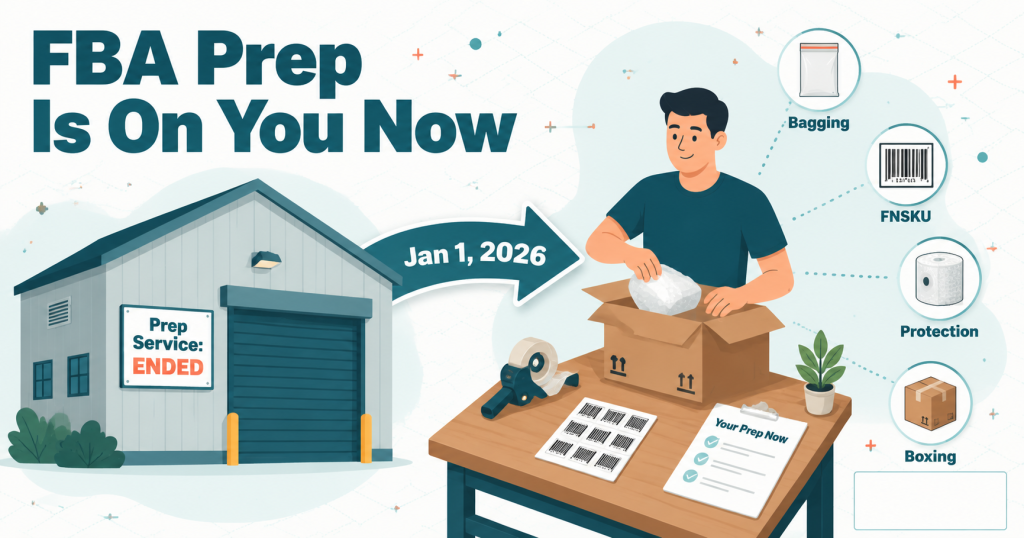
Amazon FBA prep services ending was the operational earthquake of this year: since January 1, 2026, Amazon no longer polybags, bubble-wraps, bundles, or labels a single unit of your US FBA inventory — every product must now arrive at their warehouses fully prepped, or it gets rejected, returned at your expense, or quietly disposed of with zero reimbursement. No appeals desk, no ‘oops’ fee to fix it on arrival. The safety net is gone.
If you’re reading this mid-2026 and still figuring out your prep setup — you’re not alone, and you’re not doomed. Plenty of sellers scraped through Q1 on the grace period and duct tape. This guide covers exactly what changed, why Amazon did it, your three realistic options, and a practical action plan to get compliant before your next shipment. Deep breath. Let’s sort this out.
Table of Contents
Amazon FBA Prep Services Ending: What Exactly Changed?
Here’s the change in one clean sentence: for any US FBA shipment created on or after January 1, 2026, Amazon provides zero prep and zero item labeling — the seller owns 100% of it.
The policy, announced back in July 2025, covers every route into the US FBA network: inventory sent directly to FBA, plus anything flowing through Amazon Warehousing & Distribution (AWD), Amazon Global Logistics (AGL), Amazon SEND, and the Supply Chain Portal. If it ends up on an FBA shelf, it must arrive shelf-ready. Amazon even scrubbed the option from its systems — ‘AMAZON’ is no longer an accepted value for prep or label owner in the Fulfillment Inbound API. They didn’t just close the door; they removed the door frame.
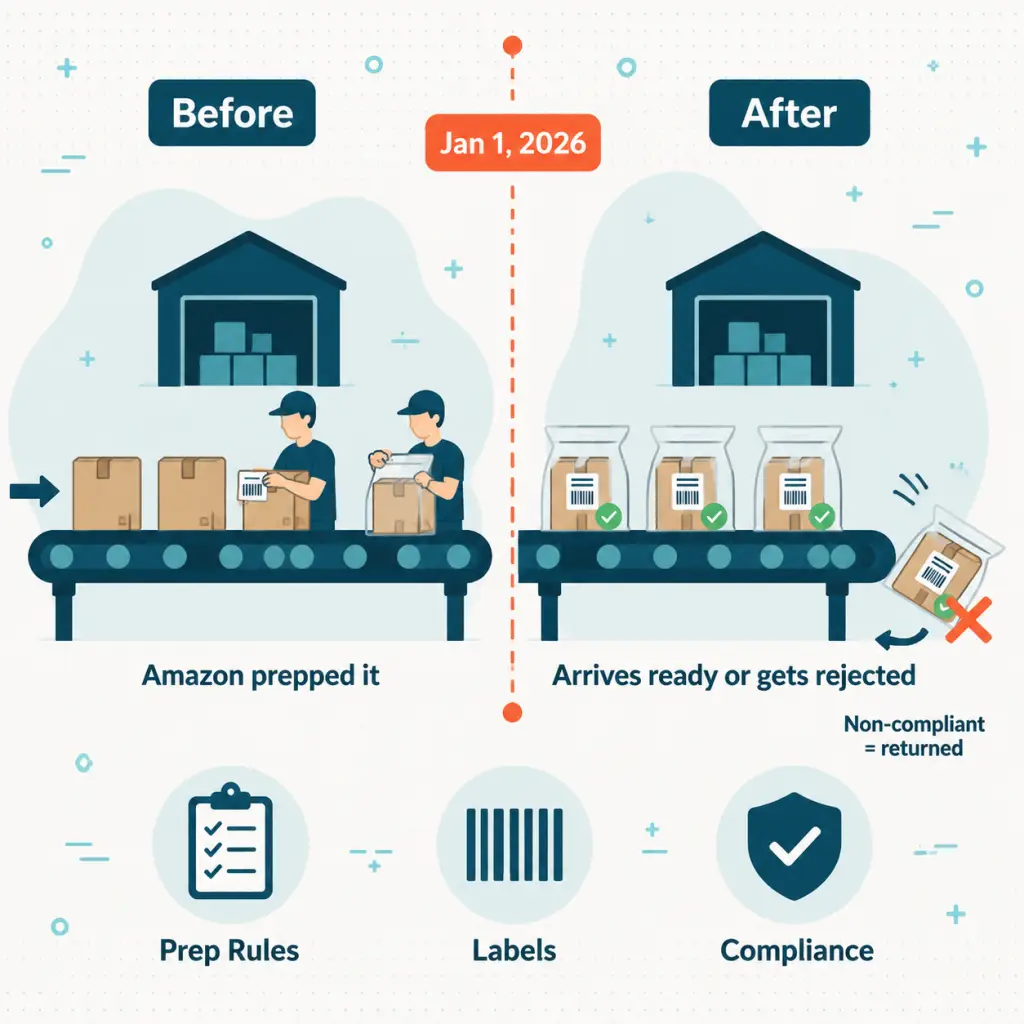
What Amazon stopped doing, specifically
- Polybagging and bubble-wrapping individual units
- Applying FNSKU barcode labels and safety labels (like suffocation warnings)
- Bundling multiple units into one sellable set (kitting)
- Boxing, taping, and other item-level compliance prep
One mercy: shipments created before January 1, 2026 remained eligible for prep even if they arrived after the deadline. That grace period is long gone now — every new shipment plays by the new rules.
Why Did Amazon Do This? (It’s Not Personal)
Amazon’s official reasoning: the vast majority of sellers now handle their own prep — in-house, through manufacturers, or via third-party providers — so removing prep lets fulfillment centers focus on what they’re built for: moving inventory fast.
The honest subtext: when FBA launched in the early 2010s, nobody outside Amazon knew what ‘item-level prep’ even meant, so Amazon built the service out of necessity. A decade later, an entire 3PL prep industry exists, and running a slow, manual, exception-heavy prep operation inside high-speed robotic warehouses made about as much sense as a hand-cranked espresso machine in a Formula 1 pit lane. Industry observers called it one of the most significant operational shifts Amazon has made in years — and for once, the observers undersold it.
There’s also a companion change worth knowing: Amazon’s commingled inventory handling changed on March 31, 2026, which reshuffled why (and whether) many sellers use FNSKU labels at all. If your labeling strategy predates both changes, it’s due for a review — not a patch.
Your 3 Options Now: DIY, Supplier, or 3PL
| DIY (In-House Prep) | Supplier-Side Prep | 3PL Prep Center | |
| Best for | Low SKU count, local inventory, hands-on sellers | High-volume imports with a trusted factory | Most sellers who want compliance without headcount |
| Typical cost | Your time + materials + space | Often cheapest per unit, negotiated into factory price | Roughly $0.40–$1.50+ per unit depending on prep type |
| Biggest risk | Scaling pain — prep eats your week as volume grows | Factory misreads Amazon’s rules; you find out at check-in | Capacity crunches and onboarding time at busy seasons |
| Control level | Total control, total responsibility | Lowest control — you’re trusting from a distance | High, with reporting — if you pick a good partner |
| Compliance expertise | You must learn Amazon’s rulebook yourself | Varies wildly — needs your detailed instructions + QC | Their entire business model — usually strongest |
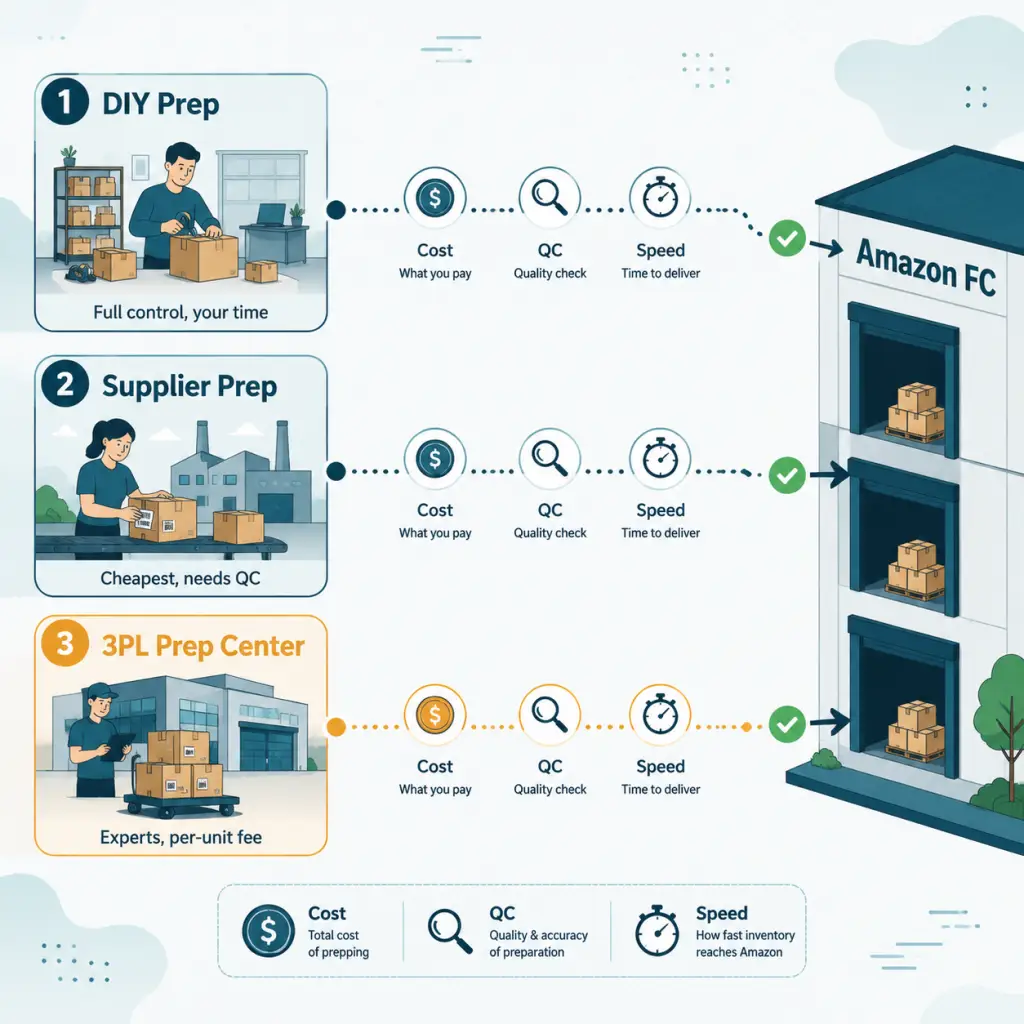
A few honest notes on this table. Supplier-side prep looks cheapest on paper, and it can be — but your factory’s understanding of Amazon’s prep rulebook is only as good as the instructions and quality control you give them. A misread polybag thickness spec discovered at Amazon check-in is a very expensive way to learn about documentation. (If you’re rethinking suppliers anyway, this pairs naturally with diversifying your sourcing beyond one country — a topic I cover separately.)
Meanwhile, 3PL prep centers have been absorbing the demand wave since the announcement, with entry pricing around $0.40 per unit at the big networks and climbing with complexity. Good ones bring compliance expertise, live unload appointments, and multi-node routing that can shave inbound placement fees. Bad ones bring… stories you’ll tell at seller meetups for years. Vet accordingly — and if the term 3PL is new to you, I’ve got a full beginner’s guide to third-party logistics coming in this series.
The Real Cost of Getting It Wrong
Post-deadline, non-compliant inventory doesn’t get a slap on the wrist — it gets consequences:
- Rejected or returned shipments, with return freight billed to you
- No reimbursement for units damaged or lost due to improper prep
- Delayed check-ins that quietly murder your in-stock rate and Prime velocity
- Stranded inventory and, in repeat cases, account health damage
For small-item, high-volume sellers, the math is especially unforgiving: thin margins multiplied across thousands of units means every prep error repeats at scale. One compliance mistake can genuinely cost a month of sales momentum — and with FBA fees already shifting this year (including the new fuel surcharge that landed in April), 2026 is not the year to donate margin to avoidable errors.
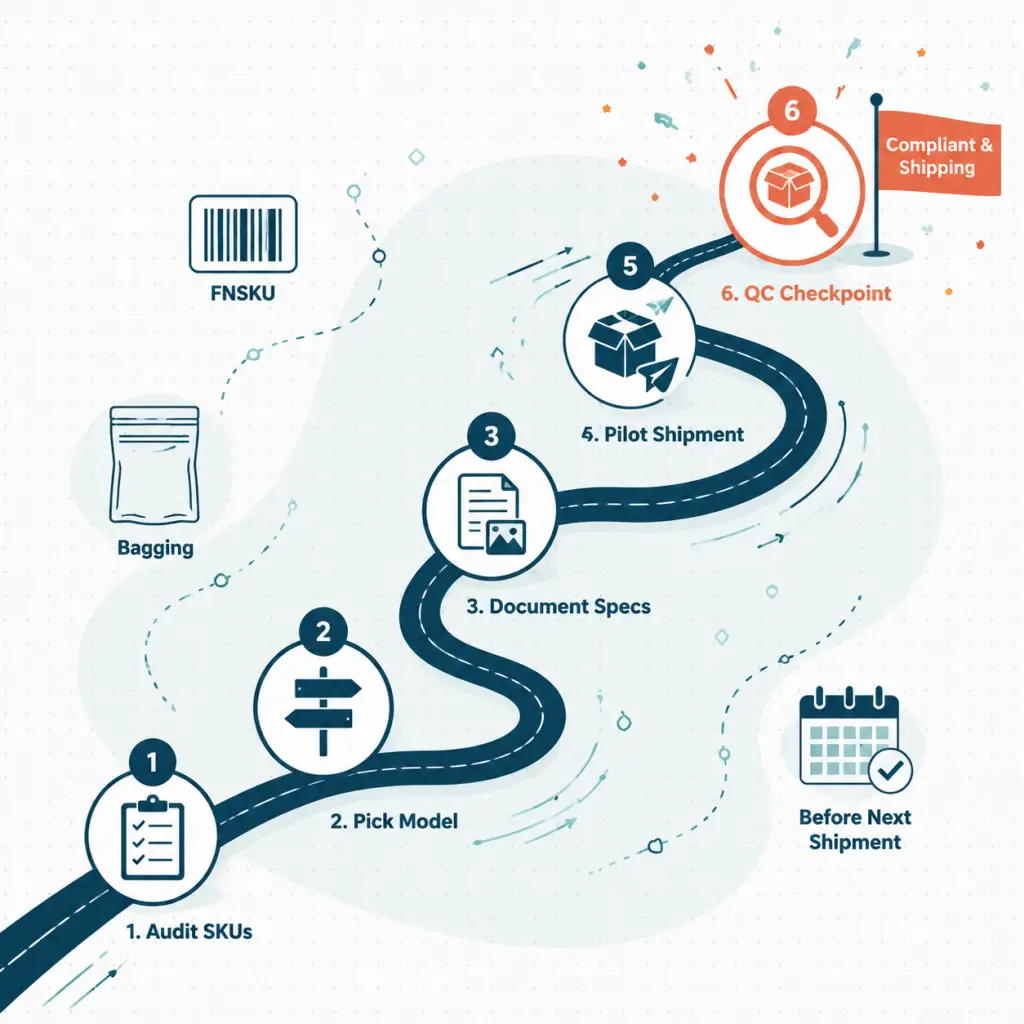
Your 6-Step Action Plan (Do This Before Your Next Shipment)
1. Audit your catalog for prep-dependent SKUs.
Map every SKU to Amazon’s current packaging and labeling requirements by category — apparel, fragile, hazmat, expiration-dated, standard. You cannot fix what you haven’t listed.
2. Pick your prep model per SKU, not per business.
Most brands land on a mix: supplier prep for high-volume stable SKUs, 3PL for complex or seasonal ones, DIY for small local batches. Match the model to the product, not to ideology.
3. Document prep instructions like a paranoid engineer.
Whoever preps — factory, 3PL, or your cousin in the garage — needs written, photo-supported specs: bag thickness, label placement, warning stickers, bundle contents. Ambiguity is where rejections are born.
4. Check Ships in Product Packaging (SIPP) eligibility.
Amazon’s SIPP program lets eligible products ship in their own packaging, cutting prep requirements at the source. Not every SKU qualifies, but for the ones that do, it’s the cheapest prep there is: none.
5. Run a small pilot before you commit volume.
Send one modest shipment through your new prep flow and watch it clear check-in before routing your whole catalog through it. Pilots are cheap; stranded containers are not.
6. Build a QC checkpoint before freight leaves.
A ten-minute photo-verification step before anything ships to Amazon catches the errors that would otherwise cost weeks. Boring? Extremely. Profitable? Also extremely.
The Bottom Line
Amazon FBA prep services ending isn’t the apocalypse — it’s a forced upgrade. Amazon pulled away the training wheels, and sellers who respond by actually understanding their own supply chain will come out sturdier, faster, and more profitable than they went in. The ones who keep improvising shipment by shipment will keep funding everyone else’s education through return fees.
Pick your prep model, document it properly, pilot it, and move on to problems that actually grow your business. And if you’d like a second pair of eyes on your FBA operation — from prep strategy to the marketing that sells what you ship — that’s exactly the kind of work I do. Let’s talk.
Frequently Asked Questions
When did Amazon FBA prep services end?
January 1, 2026, for all US FBA shipments. The change was announced on July 28, 2025, giving sellers roughly five months to transition. Shipments created before the deadline remained eligible for prep as a grace period, even if they arrived after it.
Does this affect AWD, AGL, or SEND shipments too?
Yes. The policy covers all inventory entering the US FBA network — including through Amazon Warehousing & Distribution, Amazon Global Logistics, Amazon SEND, and the Supply Chain Portal. If it ends up in FBA, it must arrive fully prepped.
What happens if my shipment arrives unprepped now?
Amazon can reject or return the shipment at your expense, or dispose of non-compliant units — and items damaged or lost due to improper prep are not eligible for reimbursement. There’s no longer an option to pay Amazon to fix prep on arrival.
Can my supplier handle FBA prep instead of a 3PL?
Yes, and for high-volume imports it’s often the cheapest option. The catch: your supplier must genuinely understand Amazon’s requirements, which means you need to provide detailed instructions, FNSKU label files, and a quality-control process. Many brands use a 3PL precisely because compliance is the 3PL’s whole job.
How much do third-party FBA prep services cost in 2026?
Entry pricing at large prep networks starts around $0.40 per unit, rising to $1.50+ depending on prep complexity — polybagging, bundling, fragile protection, and labeling all price differently. Demand surged after the policy change, so locking in a partner early tends to secure better rates.
Does the FBA prep change apply outside the United States?
The January 2026 discontinuation applies to the US marketplace. Requirements in other marketplaces follow their own policies — always verify the current rules in Seller Central for each marketplace you ship to.
This isn’t the only operational shift sellers are dealing with in 2026 — see how the 2026 Amazon fee changes compound the cost pressure, and revisit the basics in our guide to supply chain management if you’re restructuring fulfillment. Supply Chain Dive’s coverage of the announcement has more detail on the timeline. Need help auditing your fulfillment workflow? Get in touch.
Sources
- FBA prep service changes — Amazon Seller Central
- Amazon to end FBA prep and labeling services — Supply Chain Dive