
Amazon FBA Fees 2026: The Complete Breakdown of Every Costly Change
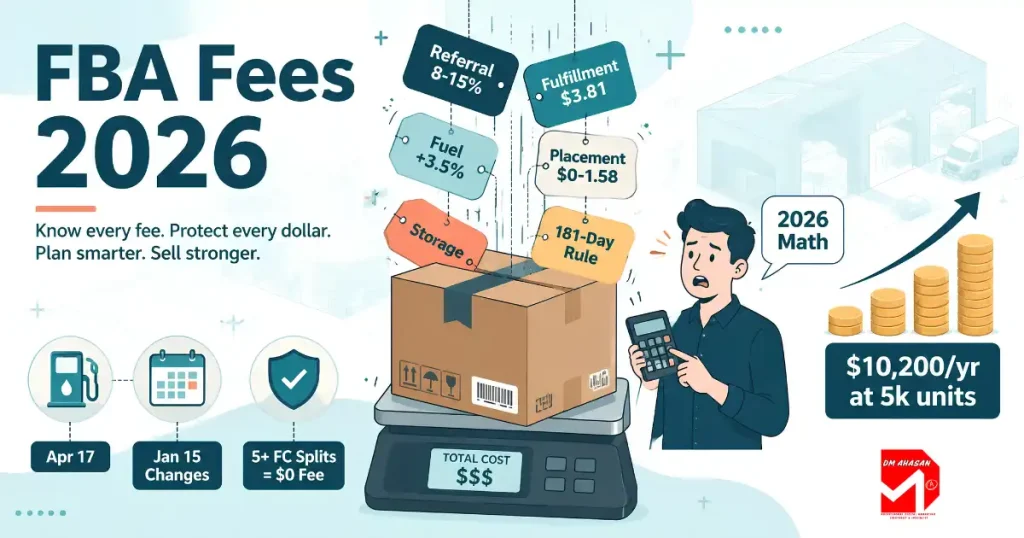
Amazon FBA fees 2026 arrived in waves, and each wave took a bite: base fulfillment fees rose an average of $0.08 per unit on January 15, a 3.5% fuel and logistics surcharge landed on every FBA fulfillment fee from April 17, aged-inventory surcharges now start at 181 days instead of 271, and the low-inventory fee expanded to nearly every category. Individually, each change sounds like pocket change. Stacked together on a 5,000-unit-a-month business, the fuel surcharge alone adds roughly $10,200 a year — which is a lot of pocket.
This guide breaks down every 2026 fee, what changed and when, a worked per-unit example, and the specific levers that actually reduce what you pay — because in FBA, margin isn’t lost in one big fee; it leaks through seven small ones.
Table of Contents
Amazon FBA Fees 2026: The Full Fee Stack
Pricing a product by referral fee plus fulfillment fee alone is how sellers go broke with excellent-looking spreadsheets. Here’s the complete 2026 stack every unit actually pays:
| Fee | What It Covers | 2026 Rate / Change |
| Referral fee | Amazon’s commission per sale | 8–15% of sale price by category |
| FBA fulfillment fee | Pick, pack, ship per unit | $3.06–$12.00+ by size/weight; avg +$0.08 (items $10–50), +$0.31 (over $50) |
| Fuel & logistics surcharge | NEW — applied to every fulfillment fee | 3.5% from Apr 17 (FBA US/CA); extended to MCF & Buy with Prime May 2 |
| Inbound placement fee | Distributing inventory across FCs | $0.21–$1.58/unit standard; $0 with Amazon-optimized splits (5+ FCs) |
| Monthly storage | Warehouse space per cubic foot | Seasonal rates; Q4 remains the expensive season |
| Aged inventory surcharge | Stock sitting too long | Now starts at 181+ days — 90 days earlier than before |
| Low-inventory fee | Stock below 28 days of supply | Now per-FNSKU and covering more categories |
| Returns processing | High-return-rate categories | Now applies to almost every category, not just apparel |
| Inbound defect fee | Non-compliant shipments | Raised sharply Jan 1 alongside the prep-service shutdown |
The Fuel Surcharge: Small Percentage, Big Bill
The headline change of 2026 is the 3.5% fuel and logistics surcharge, effective April 17 on all FBA fulfillment fees in the US and Canada (and Remote Fulfillment into Canada, Mexico, and Brazil), extending to Multi-Channel Fulfillment and Buy with Prime on May 2. The math is simple: multiply any published fulfillment fee by 1.035. A $3.68 fee becomes ~$3.81 — about 13 cents per unit.
Amazon justified it with Brent crude hovering around $107 a barrel and described it as ‘temporary’ — while notably declining to provide an end date. Veterans will remember the 2022 fuel surcharge, also ‘temporary,’ which was eventually rolled quietly into base rates like a houseguest who started receiving mail. Plan your pricing as if this one stays.
Why sellers got blindsided: 3.5% sounds ignorable, but it stacks on top of the January base increase, applies to every single unit, and was announced mid-year after most sellers had locked 2026 pricing. At 5,000 units/month, that’s ~$850/month — $10,200/year — from one line item nobody modeled.
The Quiet Changes That Hurt More Than the Loud One
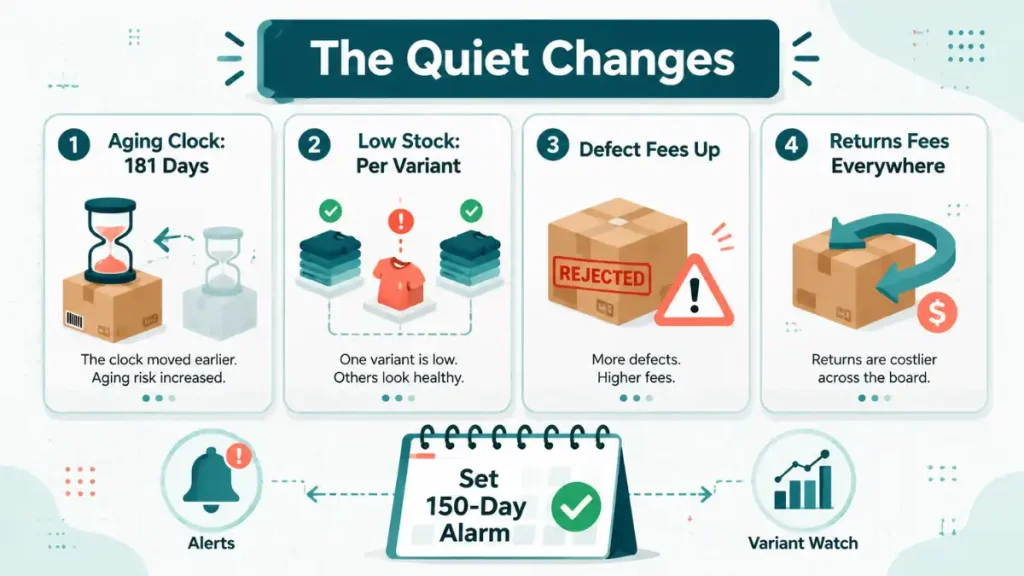
Aged inventory clock moved up 90 days. Surcharges now begin at 181 days of storage. Inventory strategy that was fine in 2025 — ‘it’ll sell eventually’ — now has a literal expiry date. Anything approaching 150 days needs a liquidation or removal decision before the meter starts.
Low-inventory fee went per-FNSKU. Previously assessed more broadly, it now triggers per variant. One slow-restocking size or color in an apparel line generates fees on every sale of that variant — even while your overall inventory looks healthy. Variant-level monitoring is no longer optional.
Inbound defect fees rose with the prep shutdown. Since Amazon ended all US prep and labeling services on January 1 (covered in my full FBA prep guide), non-compliant shipments face steeper defect fees with no ‘pay Amazon to fix it’ fallback. Prep discipline is now a fee-avoidance strategy.
Returns processing expanded to almost everything. What was once an apparel-and-shoes problem now touches most categories with elevated return rates. If your product photography or sizing info causes avoidable returns, those returns now bill you twice — lost sale plus processing fee.
A Worked Example: What One Unit Really Pays
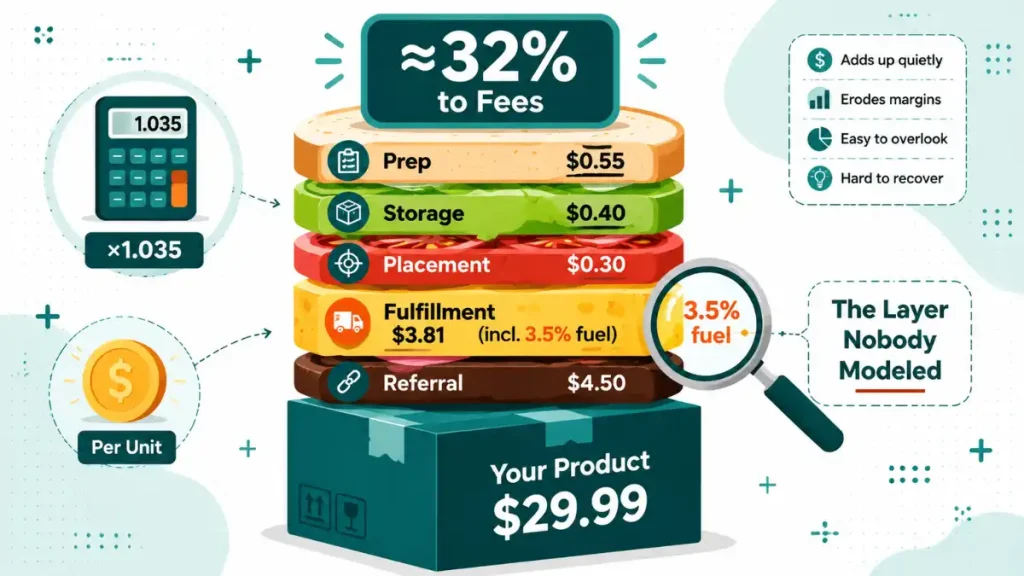
Take a standard-size product selling at $29.99 with a $3.68 base fulfillment fee and 15% referral category:
- Referral fee: $4.50 (15%)
- Fulfillment fee: $3.68 + 3.5% surcharge = $3.81
- Inbound placement (minimal split): ~$0.30
- Monthly storage allocation: ~$0.40 (varies by season and turnover)
- Freight-in, prep (3PL): ~$0.55
Total Amazon-and-logistics cost: roughly $9.56 — about 32% of the sale price, before your product cost, advertising, or overhead. That’s the honest 2026 baseline. Sellers pricing off 2024 assumptions are effectively donating 2-4 margin points to nostalgia.
5 Proven Levers to Pay Less
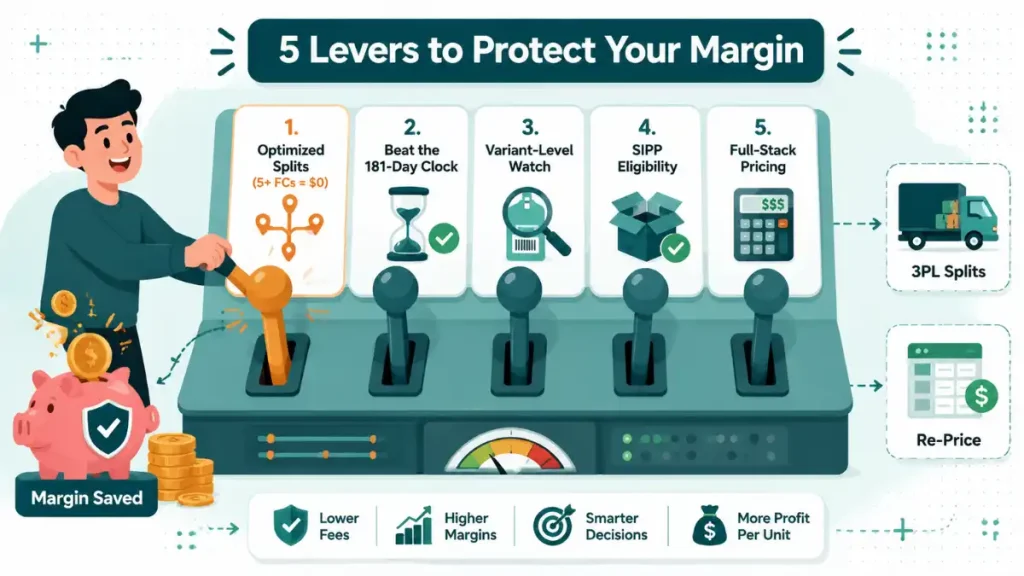
1. Use Amazon-optimized shipment splits. Ship to five or more fulfillment centers with at least five identical cartons per item and the placement fee drops to zero. At volume, this single routing choice saves thousands per shipment — a 3PL with FBA experience can handle the splits if your own logistics can’t.
2. Fight the 181-day clock proactively. Set an internal alarm at 150 days. Liquidate, bundle, promote, or remove — anything beats paying rent-plus-penalty on stock that isn’t moving.
3. Watch supply at the variant level. Keep every FNSKU above 28 days of supply. One neglected variant now quietly taxes every sale it makes.
4. Check SIPP eligibility. Ships in Product Packaging waives certain packaging-related costs for qualifying products — the cheapest prep and material spend is the kind you eliminate.
5. Re-run your pricing with the full stack. Use Amazon’s Revenue Calculator, add the 1.035 surcharge multiplier, placement, storage, and prep — then set prices. If a SKU can’t carry the 2026 stack, better to learn it in a spreadsheet than in your bank statement.
The Bottom Line
Amazon FBA fees 2026 didn’t bring one dramatic increase — they brought a coordinated squeeze: slightly higher base fees, a surcharge on top, earlier aging penalties, per-variant low-stock fees, and stricter inbound standards, all in the same year prep responsibility landed on sellers. The sellers thriving mid-2026 are the ones who re-priced with the full fee stack, optimized inbound routing to zero out placement fees, and put inventory discipline on a calendar instead of a hope.
FBA remains a genuinely powerful machine — it just stopped subsidizing inattention. If you’d like a second pair of eyes on your fee exposure and pricing strategy — alongside the marketing that actually moves the units — that’s exactly what I do. Let’s audit your numbers before Q4 does.
Frequently Asked Questions
What changed in Amazon FBA fees for 2026?
The major changes: base fulfillment fees rose ~$0.08/unit on January 15; a 3.5% fuel and logistics surcharge applies to all FBA fulfillment fees from April 17 (MCF and Buy with Prime from May 2); aged-inventory surcharges now start at 181 days; the low-inventory fee became per-FNSKU across more categories; returns processing fees expanded to most categories; and inbound defect fees rose alongside the January 1 end of Amazon’s prep services.
How do I calculate the 3.5% fuel surcharge?
Multiply your published FBA fulfillment fee by 1.035. A $3.68 fee becomes about $3.81 — roughly $0.12–$0.17 extra per standard unit. It applies per unit sold, so annualize it against your volume to see the real impact.
Is the fuel surcharge permanent?
Amazon calls it temporary but has given no end date — and the similar 2022 ‘temporary’ surcharge was eventually folded into base rates. Prudent sellers are pricing as if it’s permanent.
How can I avoid the inbound placement fee?
Use the Amazon-optimized shipment splits option: ship to five or more fulfillment centers with at least five identical cartons per item and the placement fee is $0. Minimal-split shipments pay $0.21–$1.58 per standard unit, more for oversize.
When does the aged inventory surcharge start in 2026?
At 181 days of storage — 90 days earlier than the previous 271-day threshold. Set internal review alerts around day 150 so you can promote, liquidate, or remove stock before surcharges begin.
Are FBA fees worth it in 2026 compared to FBM?
For most standard-size, decent-velocity products, yes — Prime eligibility and Amazon’s logistics scale still outperform self-fulfillment on total cost. But the margin for sloppiness shrank: slow-turning, oversized, or low-priced items deserve an honest FBA-vs-FBM comparison this year.
Amazon FBA Fees 2026 Explained by Travis Marziani
These fee changes don’t exist in isolation — they land right alongside Amazon’s FBA prep services ending, another 2026 shift worth planning around. If you’re rethinking your fulfillment setup from the ground up, our beginner-friendly guide to supply chain management is a good next read. For the exact, Amazon-published fee changes, see Amazon’s 2026 fee change summary. Navigating these shifts with an international supply chain specialist can save real margin — get in touch.
Sources
- Amazon FBA Fees 2026 Explained — Travis Marziani (YouTube)
- 2026 fee change summary — Amazon Seller Central