
AI in Classroom Teaching: How It’s Changing Education in 2026 (For Better and Worse)
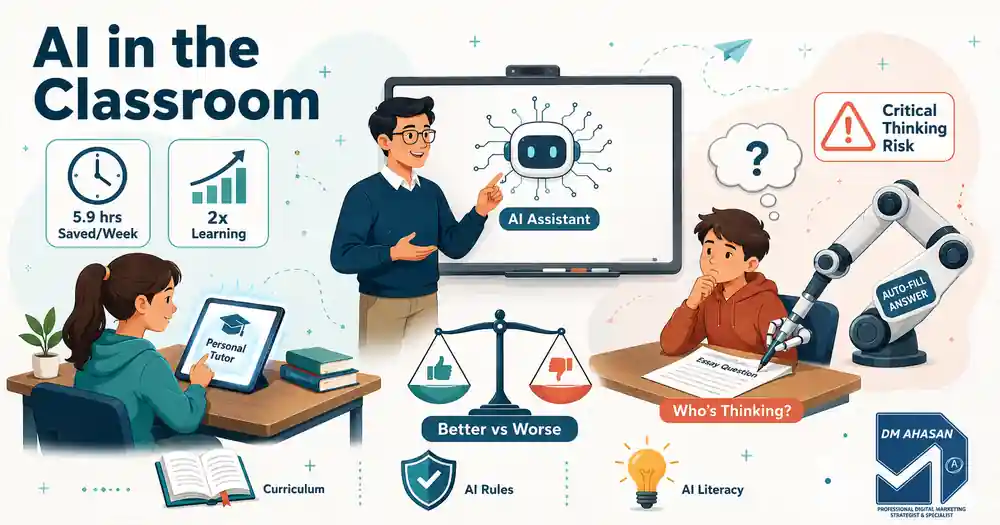
AI in classroom teaching went from science fiction to Tuesday morning in about three years flat: teacher adoption nearly doubled from 34% in 2023 to 61% by 2025, the vast majority of students now use AI for schoolwork, and the technology that was banned in half the world’s classrooms in 2023 is now writing lesson plans in most of them. Rarely has education — an industry that took decades to warm up to calculators — moved this fast on anything.
I write this wearing two hats: as a digital marketing consultant, and as someone who teaches and mentors students in AI-powered marketing courses. I’ve watched AI genuinely transform how my students learn — and I’ve also watched it quietly do some of their thinking for them. So this isn’t a cheerleading piece or a doom piece. It’s an honest look at both columns of the ledger, backed by what the 2026 research actually says.
Table of Contents
AI in Classroom Teaching: Where We Actually Are in 2026
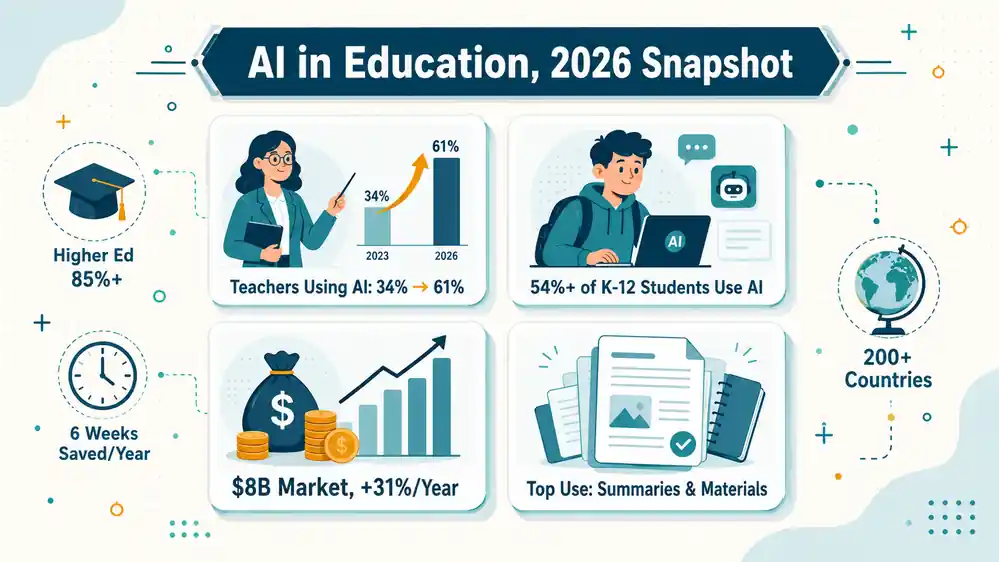
Let’s establish the landscape with numbers rather than vibes. AI in classroom teaching means teachers and students using tools like AI chatbots, adaptive learning platforms, AI tutors, and automated grading systems as part of everyday instruction — and by 2026, that’s no longer a niche experiment:
- 61% of teachers use AI in their work, per EdWeek Research Center — nearly double 2023’s figure. Among high school teachers, adoption runs closer to 69%.
- Student adoption is even steeper: a September 2025 RAND survey found 54% of K-12 students using AI for school, while in higher education, usage estimates run above 85%.
- The education AI market hit roughly $7.5–8.4 billion in 2025 and is projected to grow at ~31% annually through 2030. Someone is buying all this; it’s schools.
- Everyday use is practical, not exotic: teachers’ top uses are research, summarizing information, and creating classroom materials; students’ top uses are summarizing, research, and generating study materials. Less ‘robot professor,’ more ‘very fast teaching assistant.’
In short: the debate about whether AI belongs in classrooms is over — attendance settled it. The real question in 2026 is how to use it without breaking the thing education exists to build: thinking.
The Better and the Worse, Side by Side
| The Better ✓ | The Worse ✗ |
| Teachers save ~5.9 hours/week on prep and grading — about 6 reclaimed weeks per school year | 70% of teachers worry AI is weakening students’ critical thinking and research skills |
| Harvard study: students with AI tutors learned more than twice as much, in less time | Students who leaned on a standard chatbot performed worse when it was taken away |
| Personalized pacing — adaptive platforms adjust to each student instead of teaching to the middle | ~65% of educators cite plagiarism and AI-written assignments as a top concern |
| 80% of students say AI has positively supported their learning (5-country survey) | 68% of urban teachers have received zero AI training — adoption is outrunning preparation |
| Accessibility wins: instant translation, text-to-speech, patient unlimited re-explanation | Equity gap: well-funded schools get AI coaches; underfunded ones get AI bans and detection tools |
The Better: What AI Genuinely Improves
1. It gives teachers their time back
Teachers who use AI at least weekly save an average of 5.9 hours per week — roughly six full weeks reclaimed across a school year. In my own course preparation, tasks that once ate an evening (drafting exercises, building quiz variations, adapting examples for different skill levels) now take minutes. The crucial part is what teachers do with that time: surveys show it flows into individualized feedback, better lesson design, and — revolutionary concept — sleep.
2. Real personalization, finally
The one-teacher-thirty-students model has always forced teaching to the middle of the class. Adaptive AI tools break that constraint. A Harvard physics study found students using a well-designed AI tutor learned more than twice as much in less time compared to a traditional active-learning classroom. Every student gets the patient, judgment-free re-explanation a human teacher physically cannot deliver thirty times per hour.
3. Accessibility and confidence
For students learning in their second language, students with learning differences, or simply shy students who’d rather not raise a hand — AI tutors are transformative. In my classes, I’ve seen students who never asked questions in a live session hold long clarifying conversations with an AI afterward. 80% of students across a five-country survey say AI has positively supported their learning. The tool doesn’t sigh, doesn’t judge, and never says ‘we covered this already.’
The Worse: What Should Genuinely Worry Us
1. The thinking-outsourcing problem
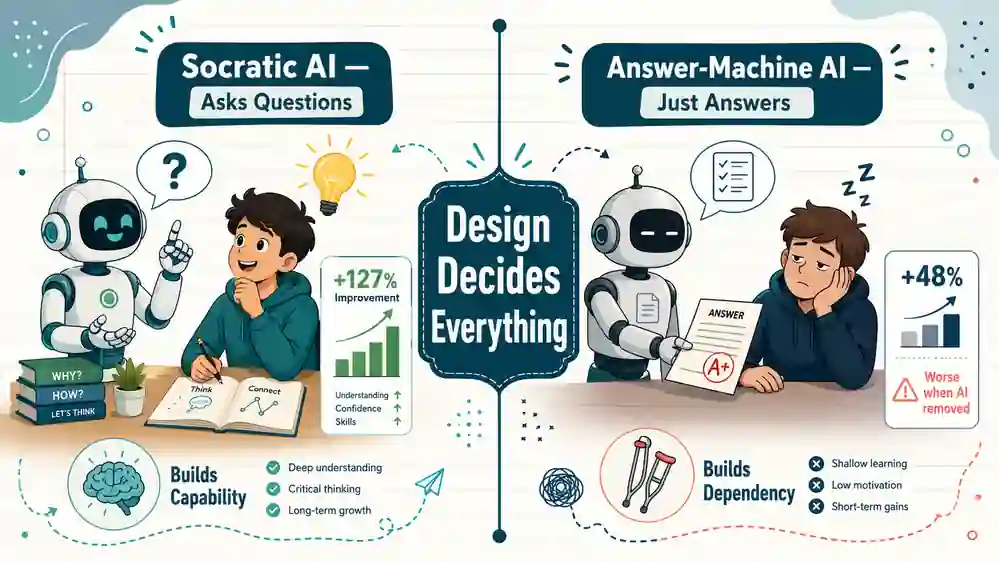
Here’s the study every educator should tape to their monitor: students using an AI tutor designed with Socratic questioning improved 127%, while students using a standard answer-giving chatbot improved 48% — and crucially, heavy users of the standard chatbot performed worse once it was removed. The design difference matters enormously: AI that asks students questions builds capability; AI that just answers builds dependency. 70% of teachers worry AI weakens critical thinking, and the data suggests they’re not being paranoid — they’re being observant.
2. Assessment is having an identity crisis
With most students now using AI on assessments in some form, the take-home essay as a measure of individual ability is, let’s be honest, on life support. About 65% of educators cite plagiarism as a top concern, and detection tools remain unreliable enough to generate both false accusations and false confidence. The forward path isn’t better detection — it’s better assessment design: oral defenses, in-class application, project work where AI use is expected and disclosed. Assess the thinking, not the typing.
3. The training gap and the equity gap
Adoption has wildly outrun preparation: 68% of urban teachers report receiving no AI training at all, and 81% of educators say they lack time to develop AI curriculum themselves. Meanwhile, a quiet equity problem grows — well-resourced schools deploy AI as a personalized tutor for every child, while under-resourced ones experience it mainly as a cheating problem to police. The same technology is widening the very gap it could be closing.
What Good AI-Era Teaching Looks Like (A Practical Playbook)
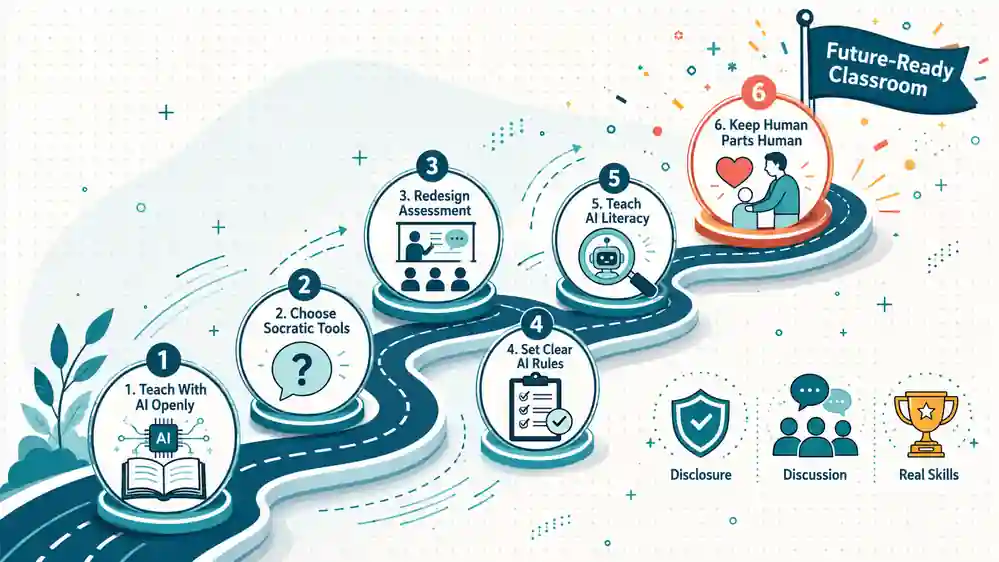
Teach with AI, openly. Model how to use it well — show students your own prompts, your fact-checking, where it helped and where it hallucinated. Mystery breeds misuse; transparency breeds literacy.
Prefer Socratic tools over answer machines. When choosing platforms, favor ones that question students rather than just answering them — the 127%-vs-48% gap is the whole argument.
Redesign assessment around application. Shift weight toward in-class work, discussion, oral explanation, and projects where the student must demonstrate understanding live. If AI can complete the entire assignment, the assignment was measuring the wrong thing.
Set explicit AI-use rules per task. ‘AI allowed with disclosure,’ ‘AI for research only,’ ‘no AI — this one’s a workout.’ Students handle clear rules far better than ambiguity followed by accusations.
Teach AI literacy as a core skill. 82% of students believe AI skills matter for their future, and they’re right. Knowing what AI is good at, where it fails, and how to verify its output is the new ‘learning to Google‘ — except with higher stakes. (This connects directly to how course design itself is evolving — a topic I cover in my guide to building curricula people actually finish.)
Keep the human irreplaceables human. Motivation, mentorship, noticing a struggling student, inspiring curiosity — no model does these. AI should absorb the repetitive so teachers can amplify the human.
The Bottom Line
AI in classroom teaching is neither the savior nor the apocalypse — it’s an amplifier. Used well, it multiplies a teacher’s reach and gives every student a tireless tutor; used lazily, it manufactures the appearance of learning while quietly hollowing out the substance. The 2026 evidence points to one clear conclusion: the outcome depends far less on the technology than on the design of how it’s used — Socratic beats answer-vending, transparency beats bans, and redesigned assessment beats detection arms-races.
Education has survived the calculator, the internet, and Wikipedia — each time by adapting what it asks of students rather than pretending the tool doesn’t exist. AI is the same test, at a larger scale, on a faster clock. And if you’re an educator or training team building AI-era courses — from curriculum design to the marketing that fills the seats — that’s work I do hands-on. Let’s talk.
Frequently Asked Questions
How is AI being used in classroom teaching in 2026?
The most common uses are practical: teachers use AI for research, summarizing information, lesson planning, and creating classroom materials, while students use it for summarizing, research, and generating study materials. Adaptive learning platforms and AI tutoring assistants are also in weekly use in a majority of K-12 classrooms.
What percentage of teachers use AI in 2026?
Around 61% of teachers report using AI in their work — nearly double the 34% of 2023 — with high school teachers adopting fastest (about 69%) and younger teachers ahead of veterans.
Does AI actually improve student learning?
It can, significantly — a Harvard study found students with a well-designed AI tutor learned more than twice as much in less time. But design matters: Socratic, question-asking AI produced far better outcomes (127% improvement) than answer-giving chatbots (48%), whose heavy users actually performed worse without the tool.
What are the biggest risks of AI in classroom teaching?
Three stand out: erosion of critical thinking when students outsource reasoning (a concern shared by 70% of teachers), plagiarism and unreliable AI detection undermining assessment, and a growing equity gap between schools that integrate AI thoughtfully and those that only police it.
Will AI replace teachers?
The evidence says no — teaching roles are projected to keep growing, because AI handles content delivery and repetition, not motivation, mentorship, or judgment. The realistic shift: teachers who use AI well will replace workflows that don’t, spending reclaimed hours on the human work machines can’t do.
How should schools handle students using AI on assignments?
Move from detection to design: set explicit per-task AI rules, require disclosure, and weight assessment toward in-class application, discussion, and oral explanation. If an assignment can be fully completed by AI, redesign the assignment rather than fighting an unwinnable detection war.
Ai in Education by Business Today
AI is reshaping more than classroom delivery — it’s also changing what credentials mean, which is why skills-based learning is gaining ground over traditional degrees. On the policy side, UNESCO’s global survey found fewer than 10% of schools and universities have formal AI guidance in place, which is exactly the gap institutions are racing to close in 2026.
Sources
- AI in Education — Business Today (YouTube)
- UNESCO survey: fewer than 10% of schools and universities have formal guidance on AI — UNESCO