
Skills-Based Learning vs Degrees: The Brutal, Shocking Truth Employers Won’t Say Out Loud
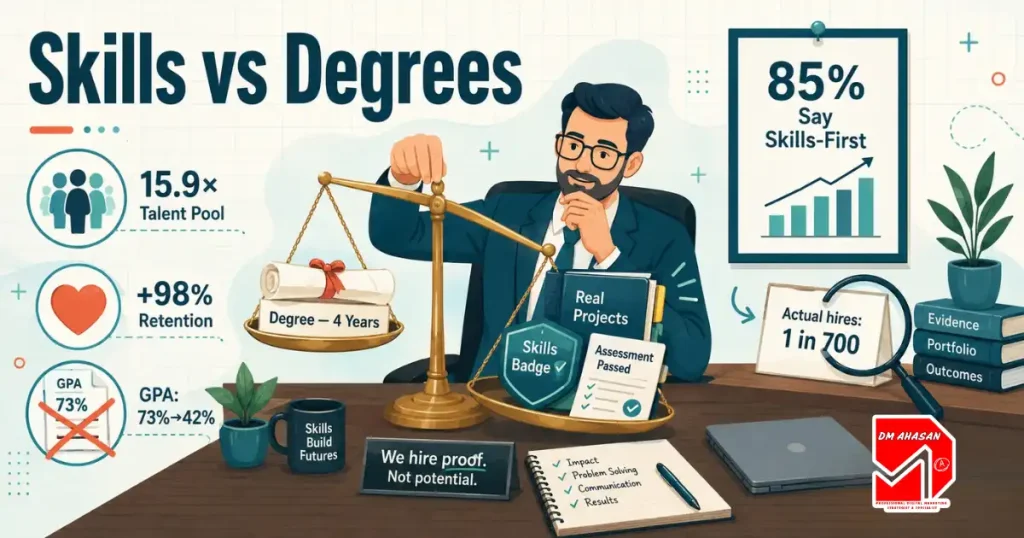
Skills-based learning — building and proving job-ready competencies through courses, certifications, projects, and practice rather than relying on a degree as the credential — is officially what employers say they want: nearly 70% now report using skills-based hiring, only 18% of US job postings still list degree requirements, and giants like IBM, Google, and Bank of America have dropped the four-year filter for huge swaths of roles. And now the brutal part nobody puts in the press release: Harvard Business School and the Burning Glass Institute examined actual hiring data at firms that publicly removed degree requirements and found fewer than 1 in 700 new hires were actually affected. Eighty-five percent talk. Zero-point-one-four percent walk.
So which is it — revolution or PR? The honest answer is: a real revolution moving slower than its own marketing, with a specific missing piece. This guide breaks down what the 2026 data genuinely shows, why the say-do gap exists, and — most practically — how learners and employers can each play the shift correctly instead of getting caught between the headline and the reality.
Table of Contents
Skills-Based Learning: What the 2026 Numbers Actually Say
First, the genuine momentum — because it is genuine:
- ~70% of employers now use skills-based hiring for entry-level roles (NACE Job Outlook 2026), up from 65% a year earlier. GPA as a screening tool collapsed from 73% in 2019 to 42% in 2026.
- Only 18% of US job postings still list degree requirements (Indeed), and formal education requirements have decreased across 87% of occupational sectors.
- The outcomes favor the shift: employers focusing on skills are 60% more likely to make successful hires (LinkedIn), skills-based organizations report 98% higher retention of high performers, and employees hired without four-year degrees stay ~34% longer in comparable roles.
- Workers feel it too: 88% of employees feel positive about skills-based hiring, and skills-based hires report higher job satisfaction (38% ‘very happy’ vs 28% of experience-based hires).
- And the pool math is staggering: skills-based approaches can expand talent pools up to 15.9× in the US — the Burning Glass Institute estimates 15.7 million capable people are currently filtered out by degree requirements on middle-skill jobs alone.
The Shocking Gap: 85% Say It, 0.14% Do It
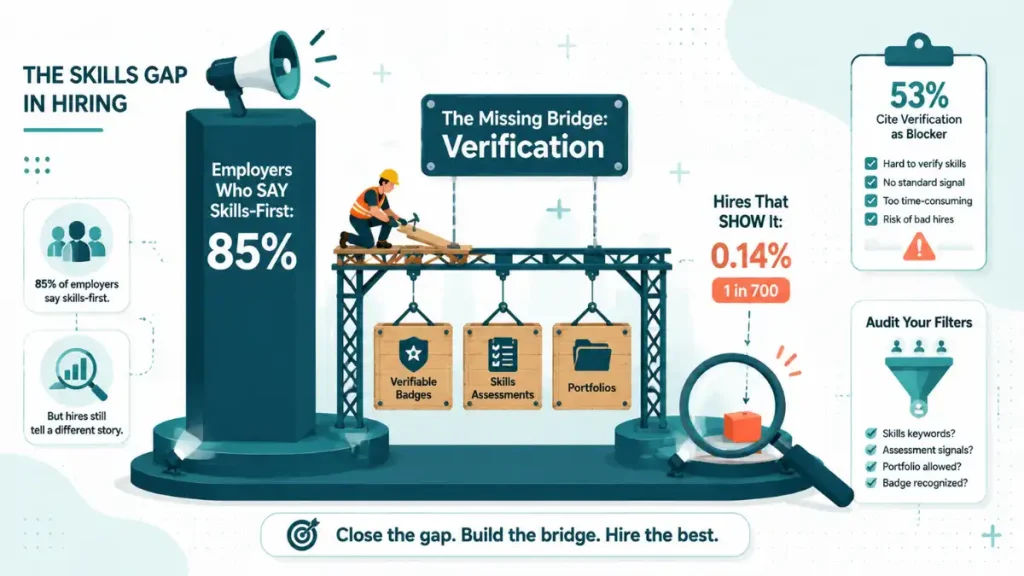
Now the cold water. When Harvard and Burning Glass audited actual hires at companies that had removed degree requirements, fewer than one in 700 hires reflected the change. A 2025 TestGorilla survey shows the same pattern from another angle: 85% of employers claim skills-based hiring, but 53% admit they’ve removed degree requirements from only some postings. The policy exists on paper; the practice is patchier than the LinkedIn posts suggest.
Why the gap? Not hypocrisy, mostly — infrastructure. A degree is a lazy but standardized signal; a skill claim on a CV is neither. When 53% of employers cite verifying skill claims as their main obstacle, and only 46% plan to expand skills-based hiring in 2026 for exactly that reason, the bottleneck reveals itself: everyone agreed to judge the play by the acting, but nobody built the audition stage. That stage is now arriving — verifiable digital credentials (Open Badges 3.0 on the W3C standard), structured skills assessments (which also cut time-to-hire 20–30%), and portfolio-based screening — and adoption of that infrastructure, not another round of announcements, is what will close the gap.
Skills-Based Learning vs Degrees: The Honest Comparison
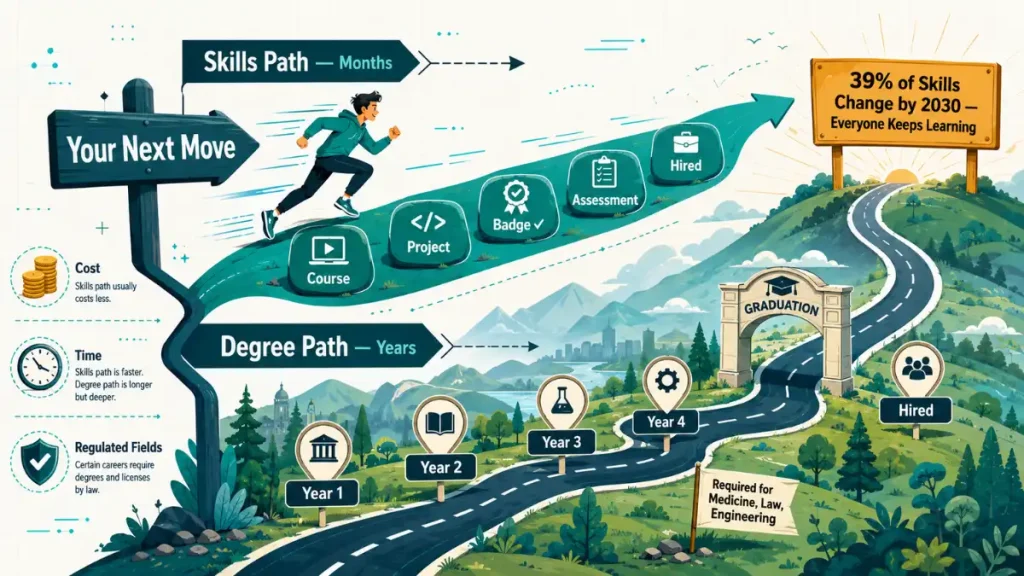
| Skills-Based Path | Degree Path | |
| What it proves | You can do the specific thing, now | You can sustain multi-year structured learning |
| Time & cost | Months; a fraction of the cost | Years; often significant debt |
| Verification | Portfolios, assessments, verifiable badges — improving fast | Standardized and universally understood |
| Where it wins | Tech, marketing, design, sales, trades, business services | Medicine, law, engineering, academia, regulated fields |
| Shelf life | Short — continuous relearning expected (39% of core skills change by 2030) | Long as a credential; content dates just as fast |
| Hidden risk | The say-do gap: skills may be undervalued at filter stage | Paying degree prices for jobs that stopped requiring one |
The mature 2026 read isn’t ‘degrees are dead’ — it’s that the degree monopoly is dead. Degrees remain non-negotiable in regulated fields and still carry weight elsewhere; but for a growing majority of roles, they’re now one signal among several rather than the gate. The World Economic Forum’s projection that 39% of core skills change by 2030 is the quiet kicker: whichever path you start on, skills-based learning is everyone’s second act.
The Playbook for Learners (How to Actually Cash In)
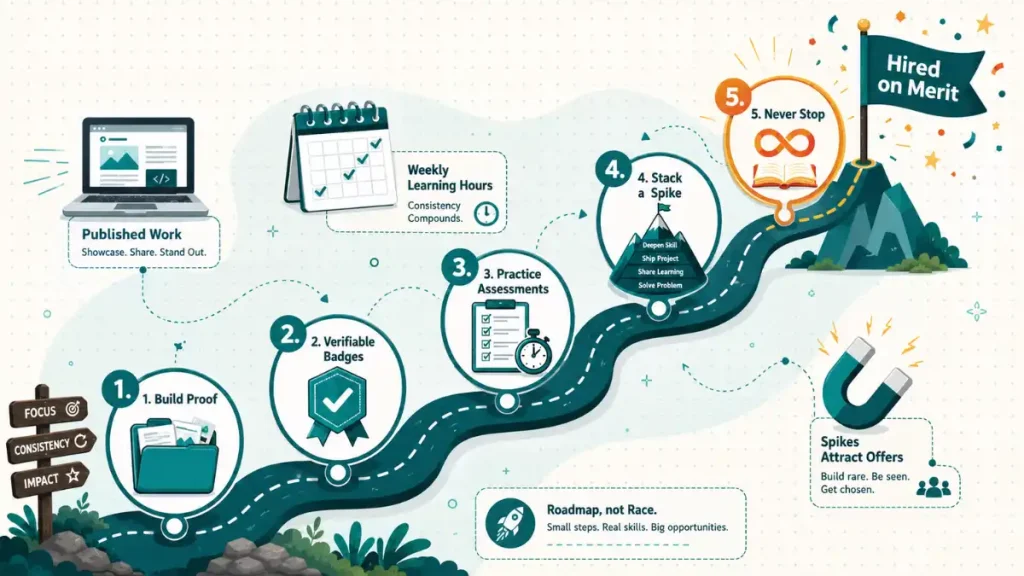
1. Build proof, not just knowledge. Employers can’t verify what they can’t see. Real projects, a portfolio, published work, and completed briefs beat a skills list every time. As someone who teaches digital marketing students: the ones who get hired fastest are never the best note-takers — they’re the ones with something to show.
2. Collect verifiable credentials, not just certificates. Employer-recognized programs and badges built on verifiable standards travel further than generic PDFs — they’re the infrastructure that closes the trust gap from the learner’s side.
3. Prepare for assessments before applying. With 79% of employers valuing skills assessments, the interview increasingly is a test. Practice the actual work under realistic conditions — the way you’d rehearse for the stage, not the way you’d cram for trivia.
4. Stack skills into a spiky profile. One deep skill plus adjacent supporting skills (e.g., SEO + analytics + AI tools) outperforms shallow breadth. Employers hire spikes, not averages. (Formats matter too — short, applied learning sticks better; my microlearning guide covers why.)
5. Never stop — literally. With core skills churning ~39% by 2030, continuous learning isn’t self-improvement content, it’s job security. Budget learning hours the way you budget rent.
The Playbook for Employers (How to Close Your Own Gap)
- Rewrite job descriptions around demonstrable skills, then actually remove the degree filter from the ATS — not just the posting copy. The 0.14% statistic lives in applicant-tracking settings nobody audited.
- Add structured work-sample assessments; they verify claims, cut time-to-hire 20–30%, and predict performance better than pedigree.
- Accept verifiable digital credentials as first-class signals, and tell candidates which ones you recognize.
- Track the ratio of non-degree hires — what gets measured stops being a press release. Companies that did this (IBM’s ‘New Collar’ program being the famous case) paired hiring changes with in-house training, which is the complete version of the move.
- Mind the diversity dividend: 86% of employers using skills-based hiring report improved workforce diversity, because degree filters disproportionately screen out capable candidates from lower-income backgrounds. Removing an artificial barrier isn’t charity — it’s widening your funnel of actual talent.
The Bottom Line
The brutal, shocking truth about skills-based learning in 2026 is a double truth: the shift is real — collapsing degree requirements, better hire outcomes, longer retention, vastly wider talent pools — and the follow-through is embarrassingly behind the announcements, held back by a verification gap that’s only now being solved. For learners, the strategy writes itself: build provable, verifiable, continuously updated skills and let the laggards’ filters miss you while the leaders’ assessments find you. For employers, the strategy is blunter: your competitors are still mostly talking; the infrastructure to actually do it now exists; the first movers get 15.9× the talent pool.
If you’re building a team, a course, or a career around real capabilities — and want help with the learning design or the marketing of it — that’s exactly the intersection where I work, from curriculum to campaign. Let’s talk.
Frequently Asked Questions
What is skills-based learning?
It’s building and demonstrating job-ready competencies through targeted courses, certifications, projects, and practice — with skills, verified through portfolios and assessments, serving as the credential rather than (or alongside) a traditional degree.
Are employers really hiring without degrees in 2026?
Increasingly, yes — with a catch. About 70% of employers use skills-based hiring and only 18% of US postings list degree requirements, but Harvard/Burning Glass research found actual non-degree hiring lagged far behind the announcements (fewer than 1 in 700 hires). The trend is real; verification infrastructure is what’s now closing the say-do gap.
Is a degree still worth it?
In regulated fields — medicine, law, engineering — absolutely, it’s required. Elsewhere, a degree remains a useful signal but no longer a monopoly: the smarter question is whether a specific degree beats the same years and money invested in provable skills for your target role. For many roles in tech, marketing, and business services, it no longer does.
What replaces the degree as proof of ability?
Three things, in combination: portfolios of real work, structured skills assessments (used by employers who report 60% better hiring success), and verifiable digital credentials built on open standards — badges that can be cryptographically checked rather than taken on faith.
Why do companies say they hire for skills but still favor degrees?
Mostly verification friction: 53% of employers say checking skill claims is their biggest obstacle, so recruiters quietly fall back on the degree as a lazy filter — often still baked into applicant-tracking settings. Companies that add real assessments and accept verifiable credentials are the ones whose hiring data actually matches their announcements.
How should students prepare for skills-based hiring?
Build a portfolio of genuine projects, earn employer-recognized and verifiable credentials, practice for skills assessments before applying (not after), and commit to continuous learning — with roughly 39% of core skills expected to change by 2030, the learning habit itself is the most durable credential.
Degree vs Skill Based Learning by Deep Messaging
This shift is happening alongside changes inside the classroom itself — see how AI in classroom teaching is already reshaping how students learn and what they’re assessed on. For a deeper dive into how employers and institutions are adapting, Deloitte has a solid overview of building a skills-based organizational strategy.
Sources
- Degree vs Skill Based Learning — Deep Messaging (YouTube)
- Building a skills-based organizational strategy — Deloitte