
Cash Flow vs Profit: The Costly Confusion That Secretly Kills Businesses

Cash flow vs profit is the distinction that decides whether your business survives — and confusing the two is one of the most reliable ways to run a ‘profitable’ company straight into a wall. Widely cited research puts cash-flow problems behind roughly 82% of small-business failures, and here’s the truly cruel part: many of those businesses were profitable on paper right up until the day they couldn’t make payroll. Profit is an opinion rendered by your accounting; cash is a fact rendered by your bank balance. Banks, landlords, and suppliers only accept the second one.
This guide explains the difference in plain language, walks through a concrete example of how a profitable business goes broke, and gives you the practical habits that keep cash — the actual oxygen of your business — flowing.
Cash Flow vs Profit: The Plain-English Difference
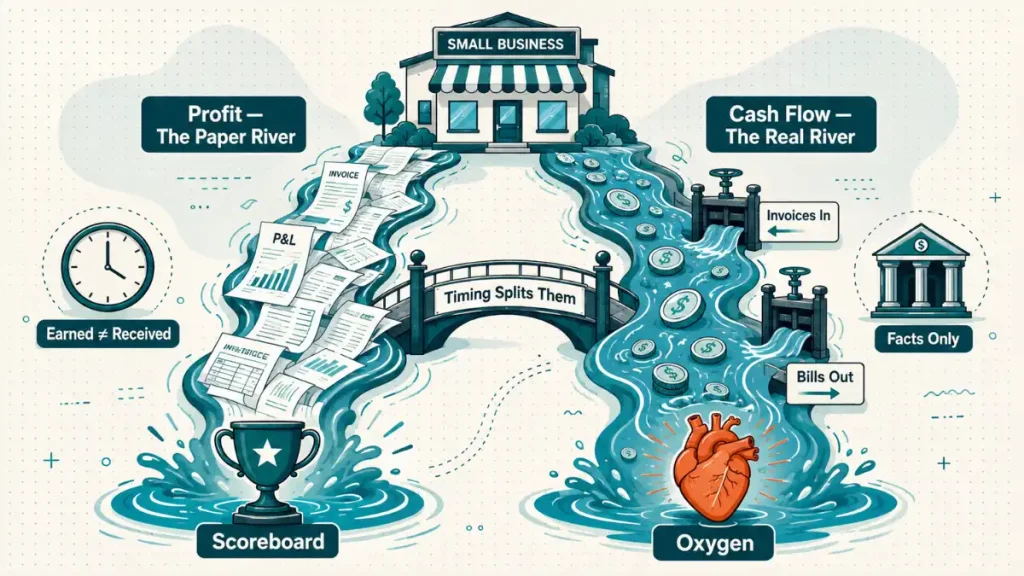
Profit is what remains after you subtract expenses from revenue on your income statement — an accounting calculation over a period. Cash flow is the actual movement of money into and out of your bank account — what you can literally spend today.
They diverge because accounting records events when they’re earned or incurred, not when money moves. You ‘earn’ revenue the day you invoice; you receive cash the day the client actually pays — which, as every agency owner knows, can be two very different calendar quarters and one very awkward follow-up email apart.
| Profit | Cash Flow | |
| What it is | Revenue minus expenses, on paper, for a period | Actual money moving in and out of the bank |
| Where it lives | Income statement (P&L) | Cash flow statement / bank balance |
| Timing | When earned or incurred (accrual) | When money actually lands or leaves |
| Can it be negative while the other is positive? | Yes — a growing, profitable firm can be cash-starved | Yes — a cash-rich month can hide an unprofitable model |
| What it answers | “Is the business model working?” | “Can we pay people on Friday?” |
| Who cares most | Investors, tax authorities, your ego | Payroll, landlords, suppliers, survival |
How a Profitable Business Goes Broke: A 90-Day Story
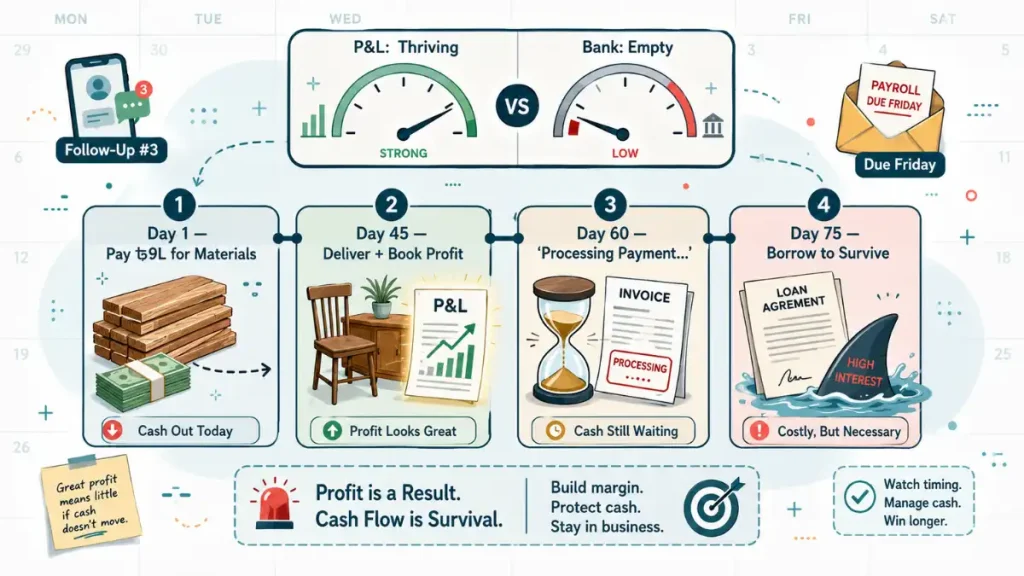
Meet a fictional Dhaka furniture maker, ‘TeakCraft.’ In January they land their biggest order ever: ৳20,00,000 of office furniture for a corporate client, 45% gross margin, payment due 60 days after delivery. On the income statement, this is a triumph.
Day 1: TeakCraft pays ৳9,00,000 upfront for timber, hardware, and extra labor. Cash out: immediate. Cash in: contractually scheduled for the distant future.
Day 45: Furniture delivered. The P&L now shows a gorgeous profit. The bank account shows a crater. Rent, salaries, and the electricity bill do not accept P&L screenshots.
Day 60: The client’s accounts department ‘is processing it.’ Meanwhile a second big order arrives — requiring another ৳8,00,000 of upfront materials TeakCraft no longer has.
Day 75: TeakCraft borrows at painful rates to buy materials and cover payroll, eating the very margin that made the orders ‘profitable.’ On paper: a thriving business. In reality: a company financing its own success with someone else’s expensive money.
Multiply this by a few cycles and you get the classic ending — a business that dies of dehydration while holding a glass of accrued revenue. Growth amplifies the problem: the faster you grow, the more cash you consume today for profit you’ll recognize tomorrow. That’s why ‘we’re growing too fast’ is a real cause of death, not a humble-brag.
The Numbers That Actually Keep You Alive
Operating cash flow: Cash generated by the core business, before financing and investments. Positive and steady = healthy heart-rate.
Cash runway: Bank balance ÷ monthly net burn. How many months you survive if inflows freeze. Under three months = act now, not next quarter.
Cash conversion cycle: Days your money is trapped between paying suppliers and getting paid by customers. Every day you shorten it is an interest-free loan from reality.
Receivables aging: Who owes you, how much, how overdue. The politely unpaid invoice is the leading predator of small businesses everywhere.
7 Habits That Keep Cash Flowing
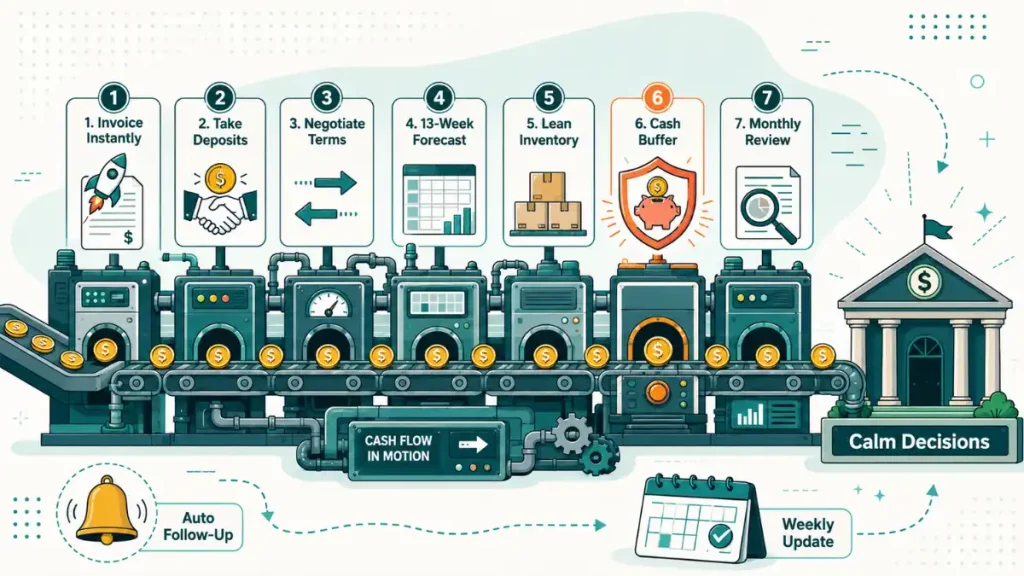
1. Invoice instantly, follow up mechanically. The day work ships, the invoice ships. Follow-ups run on a schedule, not on courage. Awkwardness is cheaper than insolvency.
2. Take deposits on big work. 30–50% upfront on large orders makes the customer share the cash-flow burden their order creates. Serious clients don’t flinch; the ones who do just told you something valuable.
3. Negotiate payment terms on both sides. Shorter terms for your customers, longer terms from your suppliers. The gap between the two is where cash comfort lives.
4. Build a 13-week cash forecast. One simple spreadsheet, updated weekly: expected in, committed out, running balance. It converts nasty surprises into scheduled decisions. (It pairs beautifully with the numbers section of a one-page business plan.)
5. Match inventory to reality. Every unit on a shelf is cash wearing a costume. Buy against demand data, not optimism — a discipline that matters double for FBA sellers now that storage fees punish slow stock earlier than ever.
6. Keep a cash buffer before you ‘invest’ profits. Two to three months of operating expenses in reserve turns emergencies into inconveniences. Then expand, then upgrade the office chair.
7. Read your cash flow statement monthly. Ten minutes. If profit is climbing while operating cash flow sinks, you’ve found the leak early — which is the entire point.
The Bottom Line
Cash flow vs profit isn’t an accounting technicality — it’s the difference between the scoreboard and the oxygen supply. Profit tells you the model works; cash flow decides whether you’re alive to enjoy it. The businesses that endure treat the two as separate dashboards: they price for profit, but they operate for cash — deposits upfront, invoices out fast, a 13-week forecast always current, and a buffer that lets them negotiate from calm instead of desperation.
If you’re building a business and want help constructing the model — pricing, margins, and the marketing engine that feeds the top line — that’s exactly the work I do with founders. Let’s make sure your success is funded by customers, not by loans against your own growth.
Frequently Asked Questions
What is the difference between cash flow and profit?
Profit is revenue minus expenses on paper, recorded when earned or incurred. Cash flow is actual money moving in and out of your bank account, recorded when it moves. A business can be profitable and cash-poor at the same time — and that combination is dangerous.
Can a profitable business run out of money?
Absolutely — it’s one of the most common ways small businesses fail. Upfront costs, slow-paying customers, and inventory tie up cash long before profit converts to money in the bank. Roughly 82% of small-business failures trace back to cash-flow problems, many at ‘profitable’ companies.
Which matters more, cash flow or profit?
Both, on different clocks. Cash flow matters more this week — it pays salaries and rent. Profit matters more over years — without it, positive cash flow is just delayed decline. Healthy businesses monitor both; surviving businesses prioritize cash first.
What is a cash flow forecast and how do I make one?
A rolling projection — 13 weeks is the practical standard — of expected cash in, committed cash out, and the running bank balance. One spreadsheet, updated weekly, is enough for most small businesses and turns surprises into planned decisions.
Why does fast growth cause cash flow problems?
Growth demands cash today (materials, staff, inventory, marketing) for revenue that arrives later. The bigger the gap between paying your costs and collecting from customers, the more each new order drains the bank — which is why scaling businesses often need deposits, credit lines, or investor cash even while profitable.
How much cash reserve should a small business keep?
A common, sensible target is two to three months of operating expenses. Enough to absorb a late-paying client, a slow season, or a surprise cost without emergency borrowing — and enough to make decisions from strategy rather than panic. According to the Federal Reserve’s Small Business Credit Survey, 44% of small businesses reported a cash-flow shortfall severe enough to delay paying expenses in the past year.