
How to Do Keyword Research in 2026: The Proven, Ultimate AI-Era Method
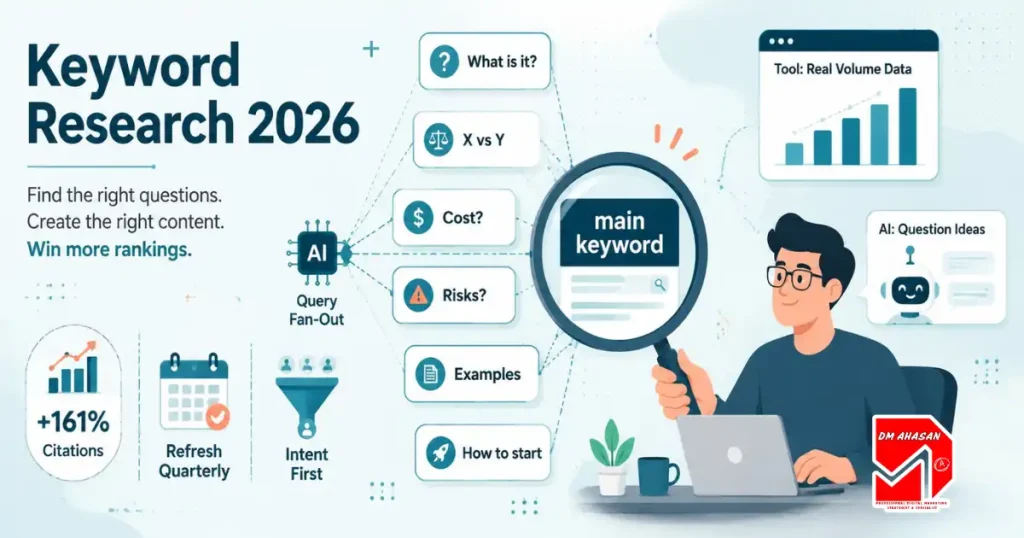
How to do keyword research in 2026 is a genuinely different question than it was three years ago — because the thing reading your keywords changed. You’re no longer just matching phrases for ten blue links; you’re covering the clusters of sub-questions that AI systems generate behind the scenes (a process called query fan-out) when they assemble an answer. The payoff for getting this right is dramatic: pages ranking for both a main query and its fan-out variants are 161% more likely to earn AI Overview citations than pages ranking for the main keyword alone.
The good news: the fundamentals didn’t die — the same research that wins Google rankings is the raw material for AI citations. This guide walks through the proven 6-step method I use, updated for the AI era: what to keep from classic keyword research, what to add, and the mistakes that quietly waste months of content effort.
Table of Contents
How to Do Keyword Research: What Changed and What Didn’t
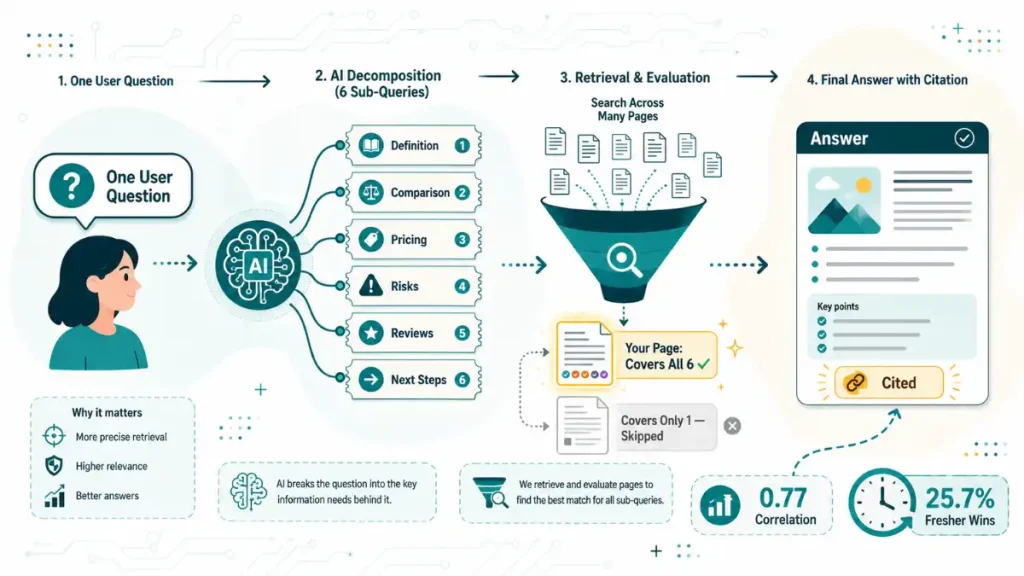
Classic keyword research asked one question: what phrases do people type, and can I rank for them? That still matters — but AI search added a second layer. When someone asks Google’s AI Overviews, ChatGPT, or Perplexity a question, the system doesn’t search for one phrase; it decomposes the prompt into multiple sub-queries — definitions, comparisons, pricing, risks, examples, next steps — retrieves sources for each, and synthesizes one answer.
The implications, backed by recent research:
- Coverage beats repetition: Research analyzing 173,000+ URLs found a strong correlation (0.77) between ranking for fan-out queries and earning AI citations — comprehensive topical coverage is the new keyword density.
- Freshness is a citation signal: AI tools cite pages that are on average 25.7% fresher than traditional search results (Ahrefs). Your 2023 evergreen post is aging in dog years.
- Ranking still helps but isn’t the whole game: 52% of sources cited in AI Overviews rank in the top 10 — which means nearly half don’t. Structure and clarity can beat position.
- The volume game is shrinking: Gartner projects traditional search volume dropping 25% by 2026 as AI chatbots absorb queries. Research for citations, not just clicks.
The 6-Step Method (Proven Fundamentals + AI-Era Additions)
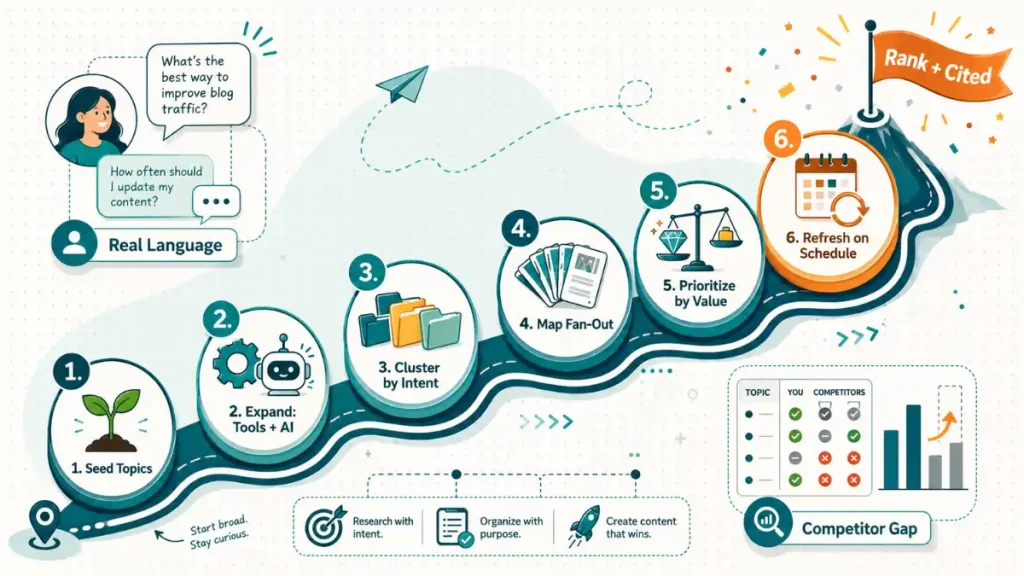
Step 1 — Start with seed topics, not keywords. List the 5–10 core problems your business solves, in your customers’ language. Talk to sales, read support tickets, check community threads. Tools expand; only you can aim.
Step 2 — Expand with tools AND an AI assistant. Use a keyword tool (Semrush, Ahrefs, or free options like Keyword Planner) for volume and difficulty data — then ask an AI assistant to generate the question landscape around each topic: definitions, comparisons, ‘vs’ queries, objections, next steps. AI is superb at the messy expansion phase (marketers report saving 1–2 hours a day) but terrible at volume data — it will guess, confidently. Use both; trust each for what it’s good at.
Step 3 — Cluster by intent, not by word similarity. Group keywords by the job the searcher is doing: learning (informational), comparing (commercial), buying (transactional). One page per intent-cluster, not one page per keyword — and match each cluster to its funnel stage (my marketing funnel guide maps this in detail).
Step 4 — Map the fan-out for your priority topics. For each cornerstone topic, list the sub-questions an AI would need answered: what is it, how does it work, X vs Y, cost, risks, examples, how to start. Your page (or cluster) should answer each — with the answer in the first sentence or two under a matching heading. This single habit is most of generative engine optimization in practice.
Step 5 — Prioritize by value, not raw volume. Score each cluster on three things: business relevance (does it attract buyers or just visitors?), winnability (can you realistically compete?), and AI-answer exposure (informational queries are increasingly answered without clicks — weight commercial-intent clusters accordingly, as my zero-click search breakdown explains). A 200-searches-a-month keyword that books calls beats a 20,000 one that doesn’t.
Step 6 — Schedule refreshes like publications, not monuments. Given the freshness signal, review high-priority pages monthly and evergreen pages quarterly. Update stats, dates, and sections — AI systems notice, and so does the ‘Updated on’ line your readers see.
Classic vs AI-Era Keyword Research at a Glance
| Classic (2015–2022) | AI-Era (2026) | |
| Unit of research | Individual keywords | Topics, questions, and entities |
| Goal | Rank in 10 blue links | Rank AND get cited in AI answers |
| Coverage logic | One keyword, one page | One intent-cluster + its fan-out sub-questions |
| Volume’s role | The main prioritization metric | One input among relevance, winnability, and click survival |
| Freshness | Nice to have | Citation signal — AI cites 25.7% fresher pages |
| Success metric | Rankings and organic traffic | Rankings + citation share + conversions |
4 Keyword Research Mistakes That Waste Months
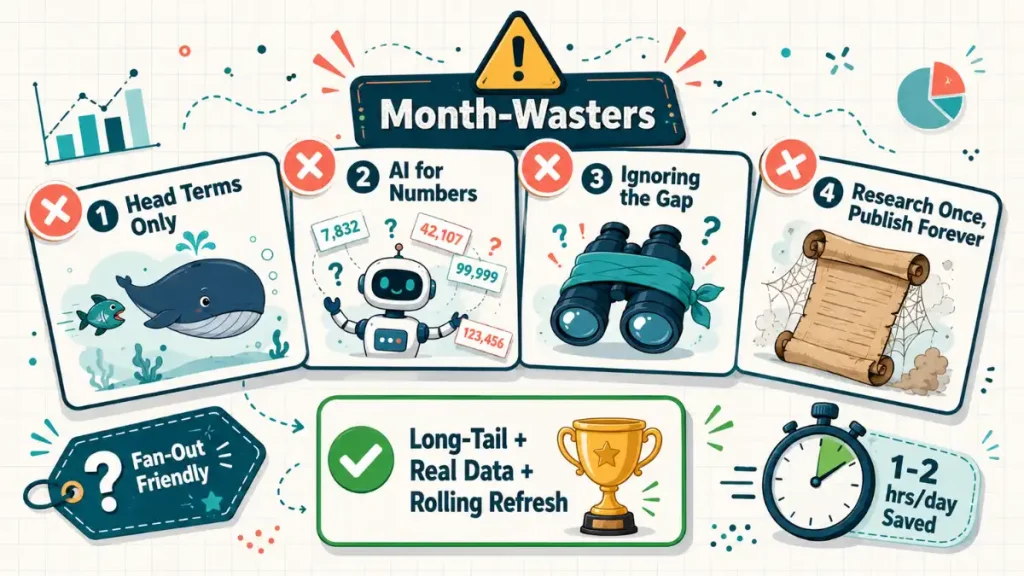
- Chasing head terms only. ‘Digital marketing’ will bury you; ‘digital marketing for furniture exporters’ will feed you. Long-tail questions are also exactly what fan-out queries look like — lower volume, higher alignment.
- Trusting AI for numbers. Language models don’t have live search-volume access; an Ahrefs review of 16 million URLs found AI assistants routinely hallucinate links and data. AI for ideas, tools for numbers, always.
- Ignoring the keyword gap. Comparing your domain against competitors reveals what they rank for that you don’t — the fastest legal way to copy someone’s homework strategy without copying their content.
- Researching once, publishing forever. A keyword list from January is a historical document by July. Rolling research beats annual research.
The Bottom Line
So that’s how to do keyword research in 2026: keep the proven core — seed topics, intent clustering, honest prioritization — and add the AI-era layer: map the fan-out sub-questions, answer each one directly, weight commercial intent, and refresh on a schedule. The unit of research shifted from the keyword to the question landscape, and the winners are the sites that cover it clearly enough for both a human skimmer and a machine summarizer.
If you’d like a done-with-you keyword strategy — research, clustering, and the content plan to execute it — that’s exactly the work I do with brands. Let’s find the questions your customers are already asking.
Frequently Asked Questions
How do you do keyword research in 2026?
Six steps: start with seed topics from real customer language, expand using both keyword tools (for data) and AI assistants (for question landscapes), cluster by search intent, map the fan-out sub-questions AI systems generate around each topic, prioritize clusters by business value and winnability rather than raw volume, and refresh research and content on a rolling schedule.
What is query fan-out?
It’s how AI search systems break one user question into multiple related sub-queries — definitions, comparisons, costs, risks, examples — then retrieve sources for each and synthesize one answer. Content that covers the full sub-question set is far more likely to be cited: 161% more likely, per research on 173,000+ URLs.
Does keyword research still matter with AI search?
More than ever — the unit just changed from single keywords to questions and entities. The same research that wins Google rankings supplies AI answers; you simply extend it to cover the sub-questions AI engines fan out into, and answer each directly.
Can I use ChatGPT for keyword research?
Yes, for expansion and clustering — it excels at generating question landscapes and intent groupings, saving marketers 1–2 hours a day. But never for volume or difficulty numbers: models have no live search data and will guess confidently. Pair AI brainstorming with a real keyword tool’s data.
How many keywords should one page target?
One intent cluster per page: a primary keyword plus its close variants and the sub-questions belonging to that same intent. Trying to rank one page for multiple intents (learning AND buying) usually means winning neither.
How often should I redo keyword research?
Lightly, monthly — check movements on priority topics and new question trends; thoroughly, quarterly. Freshness now influences AI citations directly (cited pages are ~25.7% fresher on average), so research and content updates belong on the same calendar.
Keyword Research method 2026 by Surfer Academy
Keyword research is only half the picture in 2026 — pair it with Generative Engine Optimization and a clear read on SEO vs GEO to make sure your content gets found by both Google and AI answer engines. For the foundational ranking factors Google itself recommends, see the Google SEO Starter Guide. Need hands-on help building a keyword-driven content strategy? Explore our SEO & Organic Growth service.
Sources
- Keyword Research Method 2026 — Surfer Academy (YouTube)
- SEO Starter Guide — Google Search Central