Marketing Funnel Explained: TOFU, MOFU, BOFU With Examples (2026)
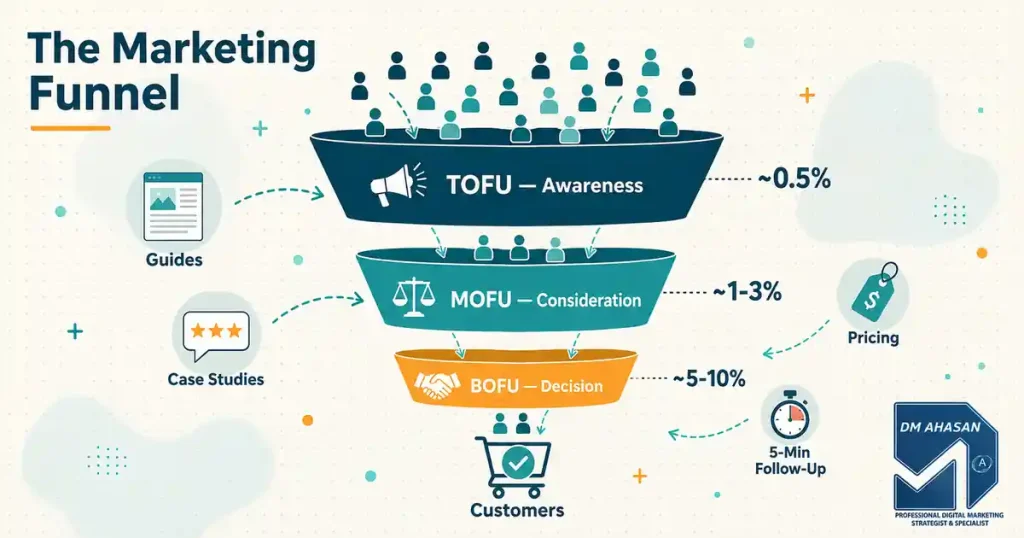
Marketing funnel explained in one breath: it’s the journey your customer takes from “never heard of you” to “take my money,” split into three stages — TOFU (awareness), MOFU (consideration), and BOFU (decision) — because only about 4% of your website visitors are ready to buy on their first visit, and shouting BUY NOW at the other 96% works about as well as proposing marriage on a first date.
If you’ve ever sat in a meeting where someone said “we need more TOFU content” and briefly wondered why marketing was discussing soy products — this guide is for you. We’ll break down each stage with real examples, the exact content and keywords that fit each one, the conversion benchmarks to expect, and the mistakes that quietly burn most marketing budgets.
Table of Contents
Marketing Funnel Explained: What It Is and Where It Came From
A marketing funnel is a model that maps how prospects move from first discovering your brand to making a purchase. It’s drawn as a funnel — wide at the top, narrow at the bottom — because people drop off at every stage: thousands see your content, hundreds consider you, and a focused few actually buy.
The idea is genuinely old: it descends from the AIDA model (Attention, Interest, Desire, Action), created by Elias St. Elmo Lewis in 1898 — making the funnel older than sliced bread, the zipper, and every marketer who has ever declared it dead. The modern TOFU/MOFU/BOFU shorthand simply repackages that 125-year-old psychology for content marketing: Attention became TOFU, Interest and Desire merged into MOFU, and Action became BOFU.
Why it still matters in 2026: buyers do more homework than ever — B2B buyers consume around 13 pieces of content and run a dozen searches before talking to any brand. Content matched to the buyer’s stage converts dramatically better than one-size-fits-all messaging; brands that map content to stage intent see up to 73% higher conversion rates. The funnel isn’t a prophecy of how people buy — it’s a filing system for making sure you have the right answer ready, whatever stage someone shows up in.
The Three Stages, Side by Side
| TOFU — Awareness | MOFU — Consideration | BOFU — Decision | |
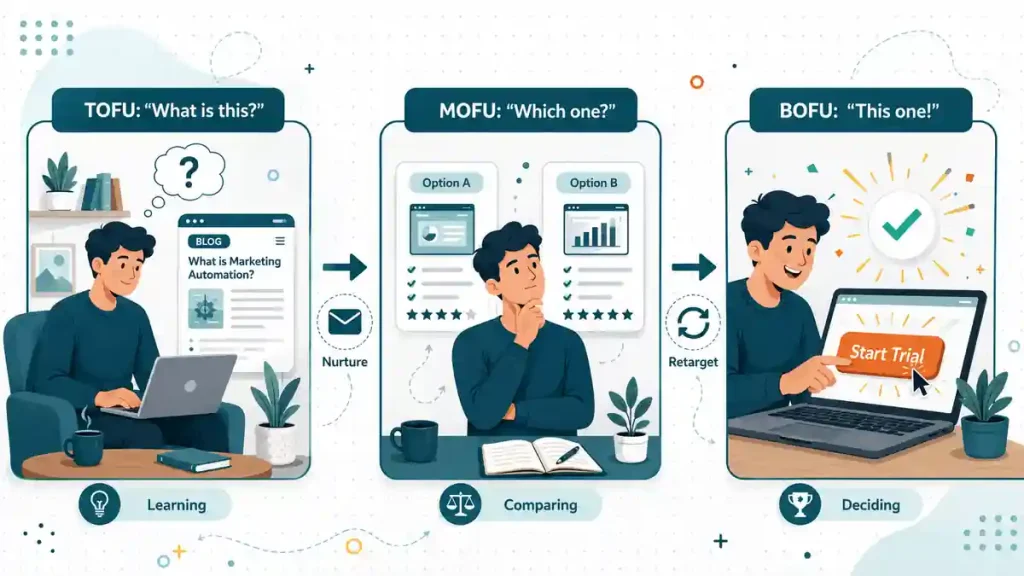
| Buyer’s mindset | “I have a problem — what even is this?” | “OK, what are my options?” | “I’m ready — is THIS the right choice?” |
| Content that works | Blog guides, how-to videos, social posts, free tools | Case studies, comparison guides, webinars, email nurture | Free trials, demos, pricing pages, testimonials |
| Search queries | “what is…”, “how does…”, “examples of…” | “best…”, “X vs Y”, “alternatives to…”, “review” | “pricing”, “demo”, “free trial”, “[brand] vs [brand]” |
| Typical conversion | ~0.3–0.6% | ~1–3% | ~5–10%+ |
| Metrics to watch | Traffic, impressions, engagement | Email CTR, MQL rate, content downloads | Demo requests, trial signups, closed revenue |
Look at that conversion row one more time: BOFU converts at roughly 10–20 times the rate of TOFU. That’s not a flaw — that’s the design. Each stage has a different job, a different audience size, and a different definition of success. Judging a TOFU blog post by sales generated is like judging a first date by whether you got a wedding invitation.
TOFU: Where Strangers Become Aware (Top of Funnel)
At the top, your buyer knows they have a problem but often can’t even name it yet. They’re searching “why is my back sore working from home” — not “ergonomic laptop stand price.” Your job is to educate generously and introduce your brand without selling.
Real example: A blog post titled “What Is Supply Chain Management?” (yes, exactly like the one on this site) attracts students, new sellers, and business owners at the awareness stage — none of them ready to hire a consultant today, all of them now aware one exists.
What works here: SEO blog guides and pillar pages, YouTube explainers, social posts and reels, free tools and calculators, podcasts.
The 2026 twist: Roughly 60% of Google searches now end without a click, as AI tools answer questions directly. That makes awareness-stage visibility a two-front game: traditional SEO plus being cited inside AI answers — which is precisely what generative engine optimization handles. TOFU didn’t die; it moved partly into the answer box.
MOFU: Where Interest Becomes Evaluation (Middle of Funnel)
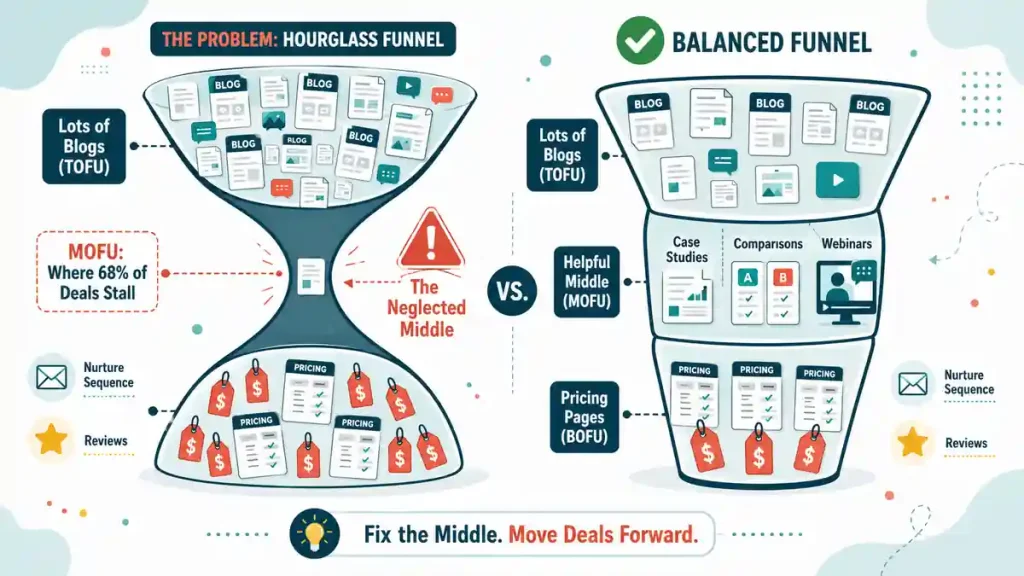
Middle-of-funnel prospects know their problem and are actively comparing solutions. They’re reading reviews, downloading comparison guides, and silently judging your case studies. This is also, statistically, where marketing goes to be neglected: about 68% of B2B deals stall in the middle, because brands pour budget into traffic (TOFU) and pricing pages (BOFU) while leaving the trust-building middle… thin. Like a sandwich made by someone who hates you.
Example: A case study showing how a SaaS client cut customer acquisition cost by 40% is classic MOFU — it doesn’t sell; it proves. A prospect comparing consultants reads it and moves one step closer.
What works here: Case studies with specific numbers, comparison guides (“X vs Y”), educational webinars, email nurture sequences segmented by behavior, retargeting ads to warm visitors.
Pro tip: MOFU keywords are commercial-investigation phrases — “best,” “vs,” “alternative to,” “review.” Lower search volume than TOFU, far higher intent.
BOFU: Where Evaluation Becomes Revenue (Bottom of Funnel)
At the bottom, the prospect has a shortlist and a budget. They don’t need more education — they need friction removed and confidence supplied. Speed matters absurdly here: responding to an inbound lead within 5 minutes makes you around 21× more likely to qualify them than waiting half an hour. The highest-intent moment in your entire funnel is the sixty seconds after someone raises their hand — and most businesses spend it composing a polite email for tomorrow.
Example: A transparent pricing page, a free strategy call offer, or a “[Your brand] vs [Competitor]” page. Serious brands winning competitive deals often maintain a comparison page per major competitor — not one vague “why us” page.
What works here: Free trials and demos, transparent pricing, testimonials placed right next to the call-to-action, guarantees and risk-reversal, fast human follow-up.
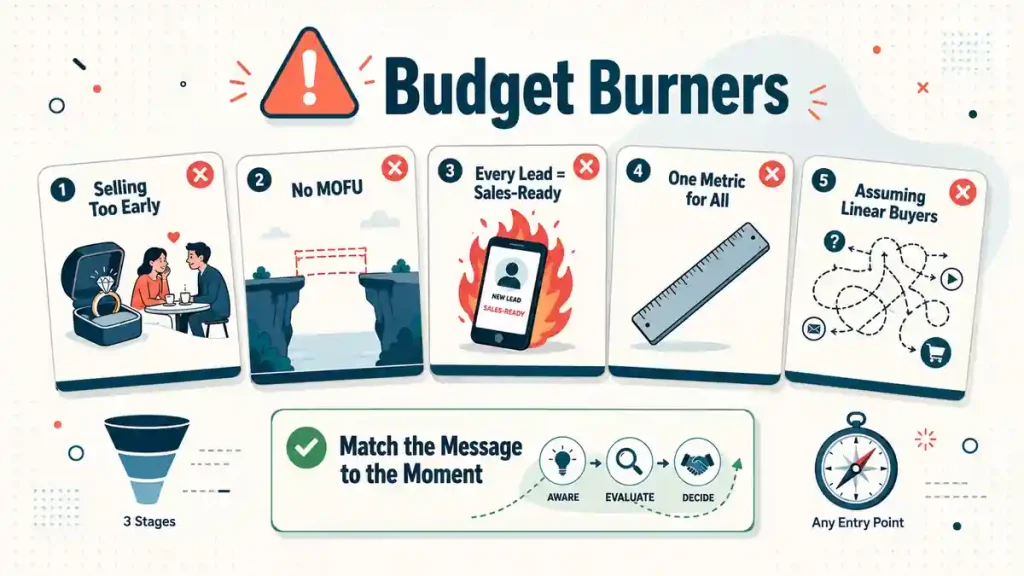
The 5 Funnel Mistakes That Burn Budgets
- Selling too early. BOFU copy aimed at TOFU strangers (‘BUY NOW’ on a first-touch ad) creates friction and teaches the algorithm to find you fewer people.
- Skipping MOFU entirely. Blog posts + pricing page with nothing in between = high traffic, low conversion, and a very confused sales team.
- Treating every lead as sales-ready. Half of leads aren’t ready to buy when they first appear; passing raw TOFU signups straight to sales burns both the leads and the salespeople.
- Measuring every stage with one metric. TOFU should be judged on qualified attention, MOFU on progression, BOFU on revenue. One number for all three tells you nothing except that someone likes dashboards.
- Forgetting the funnel isn’t linear anymore. Modern buyers zigzag — reading your pricing page before your blog, arriving via an AI answer, disappearing into WhatsApp groups you’ll never track. Build content for all three stages so whichever door they enter, the room is furnished.
The Bottom Line
So that’s the marketing funnel explained without the jargon fog: three stages, three mindsets, three kinds of content — awareness (TOFU), consideration (MOFU), decision (BOFU) — held together by one rule: match the message to the moment. The funnel isn’t a conveyor belt buyers obediently ride; it’s your checklist for being useful at every point where they might meet you.
Audit your own content this week: count your TOFU, MOFU, and BOFU pieces. Most businesses discover they’ve built a funnel shaped like an hourglass — heavy on blogs and pricing, starving in the middle. If you’d like help designing a full-funnel strategy that actually connects traffic to revenue — that’s precisely the work I do with brands. Let’s map yours.
Frequently Asked Questions
What is a marketing funnel in simple terms?
It’s a model of the customer journey from first hearing about your brand (top) to buying (bottom), shaped like a funnel because people drop off at each stage. It helps you create the right content for each mindset instead of pitching everyone the same way.
What do TOFU, MOFU, and BOFU stand for?
Top of Funnel (awareness — buyers discovering a problem), Middle of Funnel (consideration — buyers comparing solutions), and Bottom of Funnel (decision — buyers ready to purchase and choosing between finalists).
What are good conversion rates for each funnel stage?
Reliable B2B benchmarks: TOFU around 0.3–0.6%, MOFU around 1–3%, and BOFU around 5–10% or higher. The steep difference is normal — each stage filters for intent, so smaller audiences convert far better.
Is the marketing funnel dead in 2026?
No — but it’s no longer linear. Buyers jump between stages, enter through AI answers or community recommendations, and often research heavily before any brand contact. Treat TOFU/MOFU/BOFU as content categories to cover rather than steps buyers must walk in order.
How much content do buyers consume before purchasing?
B2B buyers typically consume around 13 pieces of content and perform roughly a dozen searches before engaging a specific brand. That’s why having content at every funnel stage matters — you’re being evaluated long before the first conversation.
Which funnel stage should a small business focus on first?
Start at the bottom and work up: make sure BOFU essentials exist (clear offer, pricing clarity, proof, fast follow-up), then build MOFU trust content, then scale TOFU awareness. Traffic without a conversion path is just an expensive audience for your competitors.
Marketing funnel explained by Rishu Sethi
Once your funnel is mapped out, the next step is putting it on paper alongside the rest of your strategy — a one-page business plan is a fast way to do that. If you’re running a SaaS business, pairing funnel work with a plan to reduce customer acquisition cost keeps growth efficient. For another breakdown of funnel stages, see HubSpot’s guide to the B2B marketing funnel. Want help building yours? Explore our Brand & Growth Strategy service.
Sources
- Marketing funnel explainer (YouTube)
- Guide to the B2B marketing funnel — HubSpot