
LDC Graduation Meaning: What It Is and Why Every Exporter Should Care in 2026
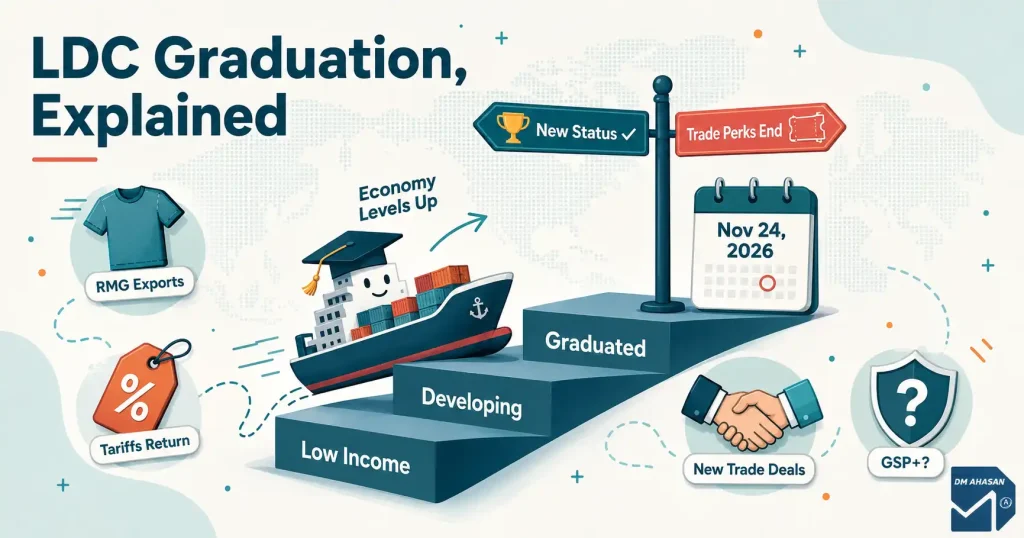
LDC graduation meaning, in one line: a country officially moves out of the United Nations’ ‘Least Developed Country’ category — a diploma for decades of economic progress that, in a twist nobody loves, arrives stapled to a bill, because graduating also means losing the special trade privileges that helped fuel that progress in the first place.
This isn’t an abstract policy topic for me. I’m writing this from Dhaka, in a country whose LDC graduation, originally set for 24 November 2026, has now been deferred to 24 November 2029 — Bangladesh remains the largest economy ever to leave the LDC list, and the one most dependent on its perks. Whether you’re a Bangladeshi exporter, a sourcing manager in Europe wondering what happens to your landed costs, or a student of international trade, this guide explains what LDC graduation actually means, what changes market by market, and what smart businesses are doing about it right now.
LDC Graduation Meaning: The Simple Definition
LDC graduation is the formal process by which the United Nations removes a country from its Least Developed Countries list, recognizing that the economy has developed beyond the category’s thresholds. A country graduates when it meets at least two of three criteria across two consecutive triennial reviews:
- Gross National Income (GNI) per capita — is the average income high enough?
- Human Assets Index (HAI) — health, education, and nutrition outcomes
- Economic and Environmental Vulnerability Index (EVI) — how exposed the economy is to shocks
Bangladesh, characteristically an overachiever here, met all three criteria — in both the 2018 and 2021 reviews — and was given a five-year runway to prepare. That runway was originally set to end on 24 November 2026, when Bangladesh was due to graduate alongside Nepal and Laos. In mid-2026, the UN Committee for Development Policy recommended, and Bangladesh’s government confirmed, a three-year extension pushing the date to 24 November 2029. Nepal secured a similar deferral; Laos remains on track to graduate in November 2026 as originally planned.
So far, so ceremonial. The catch is what the LDC label carries with it: duty-free market access to most rich-country markets, relaxed WTO rules, permission for export subsidies, and softer intellectual-property obligations. Graduate, and those privileges begin a farewell tour.
Why This Is a Bigger Deal for Bangladesh Than Any Country Before It
Every graduating country loses something. Bangladesh is losing more than anyone ever has, for a simple reason: no country has ever leaned on LDC benefits this successfully.
- Roughly three-quarters of Bangladesh’s merchandise exports enter world markets under LDC-specific duty-free preferences — the highest reliance of any LDC in history.
- Bangladesh is the largest LDC by every measure that matters: about 15% of the total LDC population, 26% of combined LDC GDP, and a full 20% of all LDC exports.
- Around 84–85% of its exports are ready-made garments (RMG) — a $47 billion industry that made Bangladesh the world’s second-largest apparel exporter, supplying more than a tenth of global demand.
- That garment dominance was turbocharged by tariff math: the EU’s average tariff on clothing is about 12%, versus 3.5% on most industrial goods. Duty-free access didn’t just help — it handed Bangladesh a 12-point head start in the world’s most tariff-heavy consumer category.
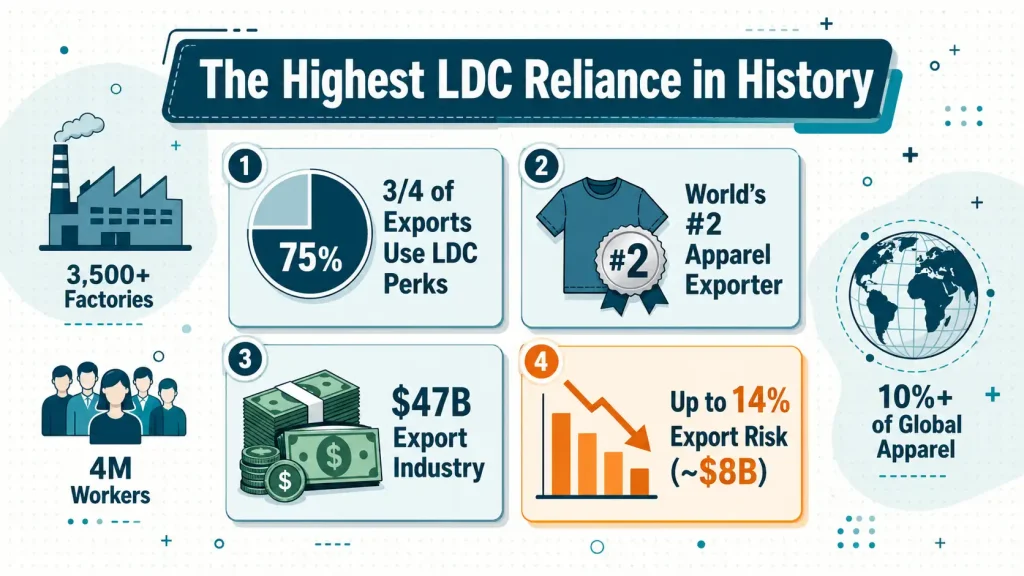
Now the other side of the ledger: the WTO estimates that losing preferential access could cut Bangladesh’s exports by more than 14% — roughly $8 billion a year. For a margin-thin industry where competitiveness is measured in single-digit percentages, a 9–12% tariff isn’t a haircut. It’s a different hairstyle entirely.
What Changes, Market by Market
| Market | Today (LDC Status) | After Graduation |
| European Union | Duty-free under Everything But Arms (EBA) | EBA continues through a 3-year transition to ~2029; then GSP+ (if qualified) or MFN tariffs of ~9–12% on apparel |
| United Kingdom | Duty-free under DCTS (Comprehensive tier) | Transition to ~2029; DCTS still offers improved access post-graduation under its Enhanced framework |
| United States | No LDC duty-free for apparel — ~15.6% duty already applies | Effectively unchanged — the US never extended LDC apparel preferences |
| China | Zero-tariff access under China’s LDC scheme | Benefit lost — no comparable scheme for non-LDC developing countries; bilateral negotiation needed |
| Canada / Australia | Duty-free LDC access (90%+ of exports enter free) | Transition support agreed to ~2029; future terms depend on each country’s scheme |
| India / Türkiye | LDC preferential access | Among the earliest expected losses — studies estimate ~$764M (India) and ~$358M (Türkiye) in export impact |
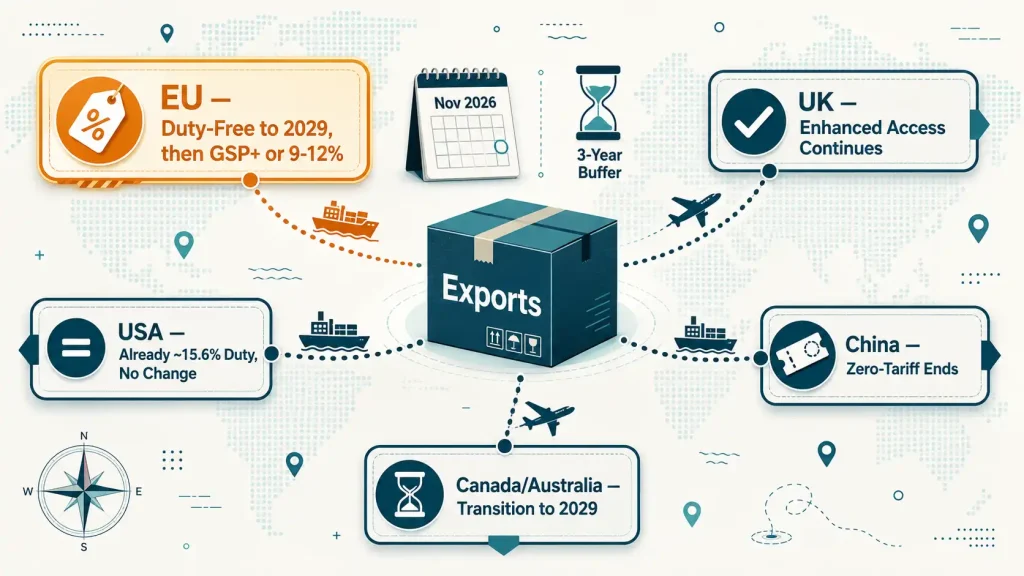
Two important nuances hide in that table. First, nothing falls off a cliff on graduation day — the EU, UK, Canada, and Australia have agreed to keep duty-free access running until around 2029, a three-year cushion. Second, the US column surprises people: American buyers have always paid roughly 15.6% duty on Bangladeshi apparel, because the US never extended LDC apparel preferences. For the ~16% of exports going to America, graduation changes almost nothing.
The GSP+ Question: Bangladesh’s Plan A (With an Asterisk)
The main lifeline after 2029 is the EU’s GSP+ scheme — continued preferential access in exchange for ratifying and genuinely implementing 32 international conventions on labor rights, environment, human rights, and governance. Bangladesh has been doing its homework: it ratified key ILO conventions (155, 187, and 190) in late 2025, moves the EU publicly welcomed.
But there’s an asterisk the size of a container ship: GSP+ includes safeguard thresholds that exclude countries whose exports dominate a product category. Bangladesh’s apparel already accounts for a share of EU imports far above those thresholds — analysts note it exceeds the limits several times over. Meaning even a successfully negotiated GSP+ might not cover the very product that makes up 85% of exports, unless the rules are adjusted in the EU’s 2027–2034 GSP revision. Dhaka formally requested deferring graduation to 2029, and in June 2026 the UN CDP confirmed the extension — the new graduation date is 24 November 2029. Coffee consumption in trade ministries presumably remains at record highs regardless.
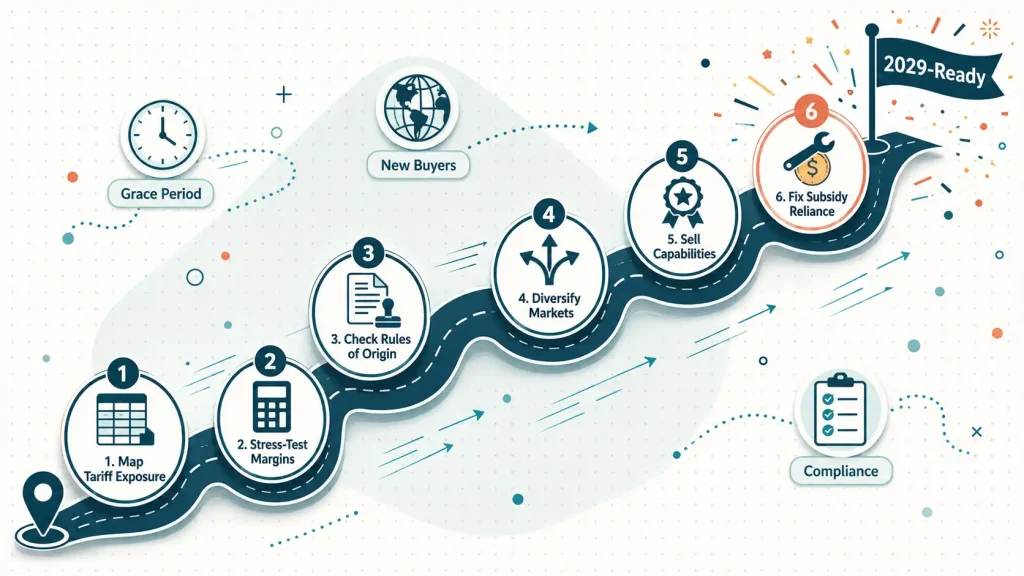
What Smart Exporters and Buyers Are Doing Now
1. Mapping tariff exposure, SKU by SKU. List your top products, identify what share goes to preference-giving markets, and calculate the landed-cost impact of a 9–12% duty. Guessing is not a strategy; a spreadsheet is.
2. Stress-testing margins. For each product, work out how much tariff you could absorb versus pass on to buyers — before your buyers run the same math and open the conversation with a discount request.
3. Checking rules of origin. GSP and GSP+ rules of origin are stricter than EBA’s. Products that qualify as ‘Bangladeshi’ today may not qualify tomorrow if too much value is added elsewhere — a real issue in value-chain-driven trade. (Trade terms and documentation are a world of their own; my guide to Incoterms covers the shipping side.)
4. Diversifying markets and products. The post-graduation winners will be exporters who reduced dependence on any single market or product line. That’s the same diversification logic reshaping global supply chains everywhere right now — Bangladesh’s exporters just have a firmer deadline than most.
5. Building the non-price pitch. Bangladesh’s advantages beyond tariffs are real: the second-lowest manufacturing cost base globally, 3,500+ export factories, four million skilled RMG workers, and one of Asia’s densest concentrations of compliance-certified factories. Tariffs change; that infrastructure doesn’t ship elsewhere overnight.
6. Preparing for subsidy phase-out. The 2–20% cash export subsidies must wind down under WTO rules for non-LDCs. If your business model needs the subsidy to be profitable, the model — not the subsidy — is the thing to fix, and 2026 is the year to fix it.
It’s Not All Loss: What Graduation Unlocks
Graduation is a downgrade in trade privileges but an upgrade in status — and status has economic value. Graduated countries typically see improved sovereign credit perception, cheaper access to international capital markets, more foreign direct investment interest, and a stronger negotiating position for the bilateral free trade agreements that ultimately replace one-way charity preferences with two-way partnerships. Bangladesh outperformed every previous graduate by meeting all three criteria with room to spare — the same underlying strength that earned the diploma is what businesses will be betting on after it.
The Bottom Line
So, the LDC graduation meaning for anyone in trade: the training wheels come off a $47 billion export machine on 24 November 2029 — pushed back three years from the original 2026 target — with transition support from key partners continuing beyond that, and a genuinely open question about what follows. For exporters, the assignment is clear — know your tariff exposure, diversify deliberately, and compete on capabilities rather than concessions. For international buyers, the message is calmer than the headlines: Bangladesh’s structural advantages survive graduation; only the discount coupon expires.
If your business touches Bangladesh’s export economy — as a manufacturer, buyer, or brand — and you want help thinking through market diversification and the digital strategy to reach new buyers, that’s precisely the intersection I work at, from right here in Dhaka. Let’s talk before 2029 does.
Frequently Asked Questions
What does LDC graduation mean in simple terms?
It means the United Nations officially removes a country from its Least Developed Countries list because the economy has grown past the category’s income, human development, and vulnerability thresholds. With the recognition comes the gradual loss of LDC-only benefits like duty-free market access and relaxed trade rules.
When does Bangladesh graduate from LDC status?
Originally 24 November 2026, alongside Nepal and Laos, following a five-year preparatory period. In June 2026, the UN CDP confirmed a three-year deferral for Bangladesh (and a similar one for Nepal), pushing the graduation date to 24 November 2029. Laos remains on track to graduate in November 2026. Major partners like the EU and UK are expected to continue offering transition benefits for several years beyond the new date.
Will Bangladeshi garments immediately get more expensive after graduation?
No. The EU, UK, Canada, and Australia continue duty-free access through a roughly three-year transition to 2029. The real pricing question begins after that — depending on GSP+ qualification, bilateral deals, or default MFN tariffs of about 9–12% on apparel in the EU.
What is the difference between EBA and GSP+?
EBA (Everything But Arms) gives LDCs duty-free, quota-free EU access for everything except weapons, with no conditions beyond LDC status. GSP+ offers similar preferences to non-LDC developing countries but requires ratifying and implementing 32 conventions on labor, environment, human rights, and governance — and includes market-share safeguard limits that complicate Bangladesh’s apparel case.
How much could Bangladesh lose from LDC graduation?
The WTO and subsequent studies estimate export losses of up to 14% — roughly $8 billion annually — concentrated in ready-made garments once preferences fully lapse. Early impacts hit markets like India and Türkiye from 2026–27, with the larger EU effect arriving after the 2029 transition ends.
Does LDC graduation have any benefits?
Yes — improved country credit perception, better access to international capital, stronger FDI appeal, and the standing to negotiate reciprocal free trade agreements. Graduation is a signal of economic maturity; the challenge is bridging the gap between losing one-way preferences and building two-way trade deals.