
What Is a 3PL? The Ultimate Guide for Smart Growing Brands
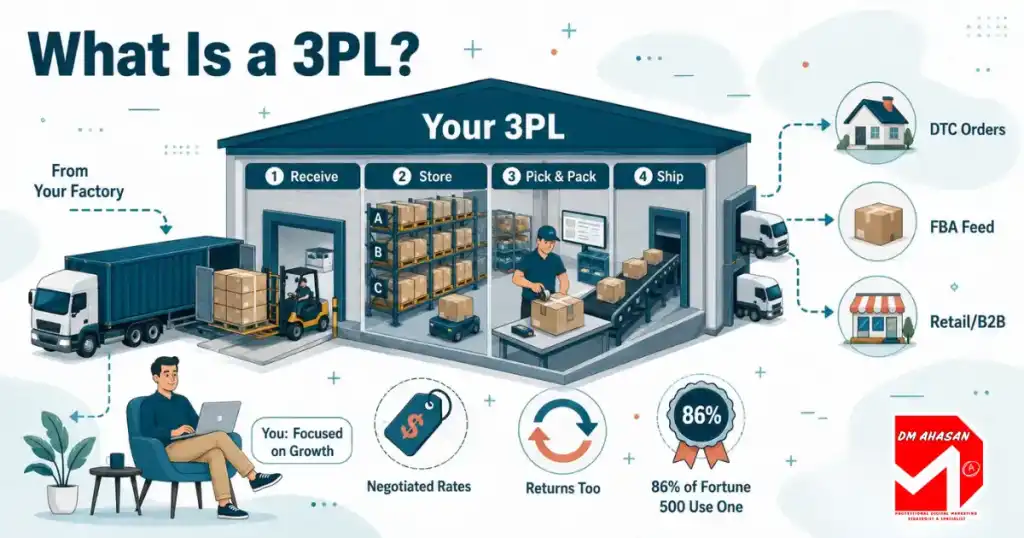
What is a 3PL? Short answer: a third-party logistics provider — a company that stores your inventory, picks and packs your orders, and ships them to your customers, so you don’t have to lease a warehouse, hire packing staff, or discover at 11 PM what a dimensional-weight surcharge is. It’s a $1.15+ trillion global industry, roughly 86% of Fortune 500 companies use one, and the brands you order from online almost never ship from a founder’s garage anymore — their inventory sits in a 3PL’s fulfillment center, moving on carrier rates no single small brand could negotiate alone.
This guide covers what a 3PL actually does step by step, what it costs in 2026, how it compares to doing it yourself or using Amazon FBA, when you’re genuinely ready for one, and the red flags to check before signing — because a good 3PL is a growth engine, and a bad one is a customer-service apology generator.
What Is a 3PL and What Does It Actually Do?
A 3PL (third-party logistics provider) handles the physical backend of your commerce operation. The core service loop looks like this:
- Receiving & inbound — unloading your containers or pallets from the manufacturer, counting and inspecting units, logging them into inventory systems.
- Storage & warehousing — holding inventory in racked, binned, or bulk storage, often across multiple locations near your customer populations.
- Pick, pack & ship — when an order comes in from your store or marketplace, the 3PL picks the items, packs them to spec (your branded box, inserts, whatever you’ve defined), and ships via negotiated carrier rates.
- Returns processing — receiving, inspecting, and restocking or disposing of returns (reverse logistics, the least glamorous and most underrated service).
- Value-added services — kitting and bundling, FBA prep and labeling, custom packaging, B2B/retail routing compliance.
The usual international flow: your freight forwarder ships goods from the factory → a customs broker clears them → drayage trucks them to the 3PL → the 3PL stores and fulfills to customers. If those first steps are fuzzy, my supply chain management pillar covers the whole chain end to end.
One clarification that saves confusion: a 4PL sits a layer above — a coordinator managing multiple 3PLs, carriers, and brokers on your behalf. If you ship under 50,000 orders a month, a 3PL is almost certainly what you need; 4PLs are enterprise machinery.
What Does a 3PL Cost in 2026?
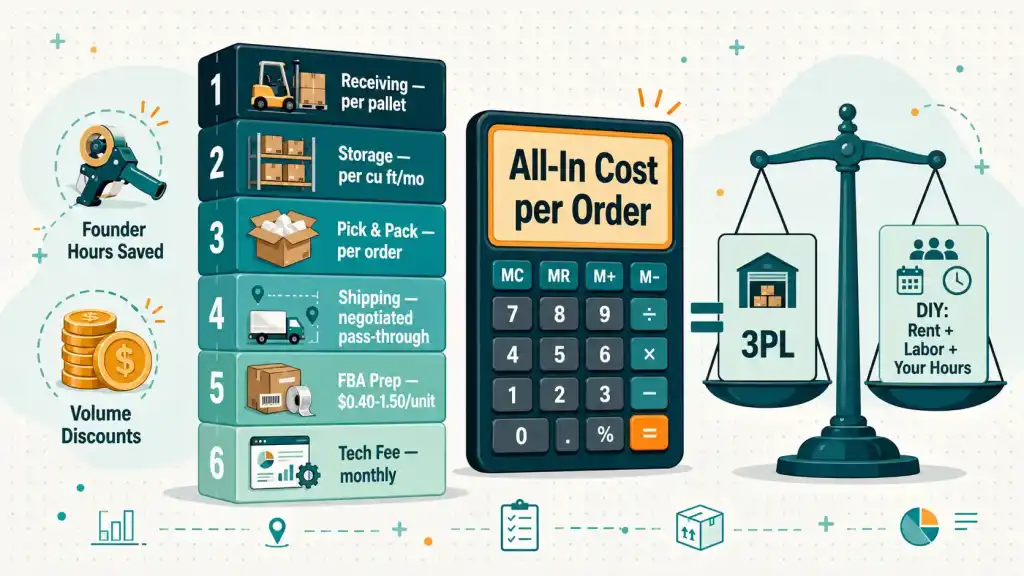
3PL pricing is modular — you pay discrete fees rather than one flat rate:
The number that matters isn’t any single fee — it’s your all-in cost per order shipped, compared honestly against what DIY actually costs you: rent, labor, materials, software, and the founder-hours you’re currently donating to tape guns.
3PL vs In-House vs Amazon FBA: The Honest Comparison
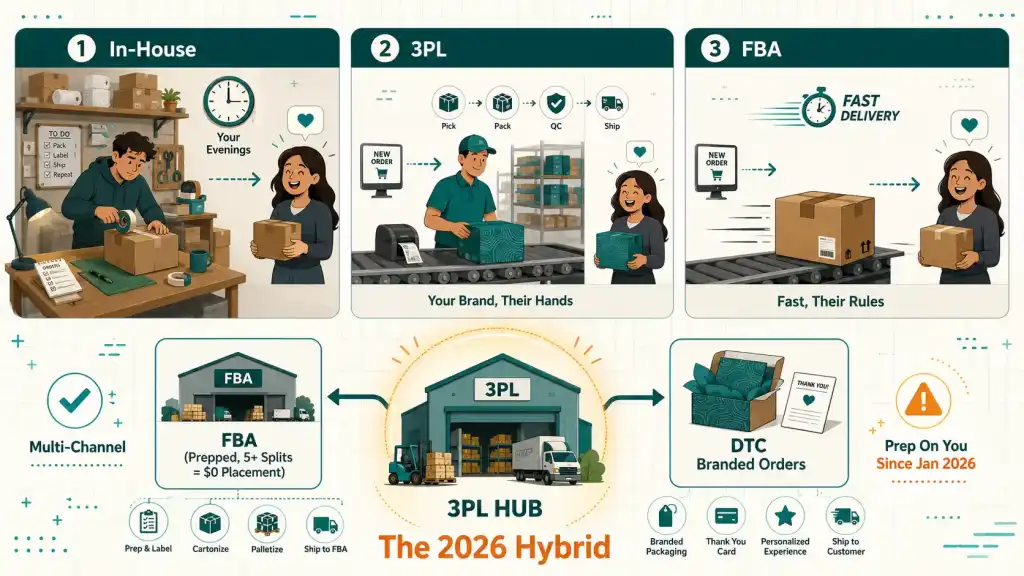
These aren’t mutually exclusive: a very common 2026 setup is a 3PL as the hub — holding master inventory, feeding Amazon FBA with prepped, optimized shipments (which can zero out inbound placement fees via 5+ warehouse splits), and fulfilling your own website’s orders in branded packaging. Since Amazon ended its own prep services in January 2026, 3PLs absorbed that demand wave — prep expertise is now one of their fastest-growing services, as I covered in the FBA prep shutdown guide.
When Are You Ready for a 3PL? (The Honest Signals)
- You’re consistently shipping roughly 500+ orders a month, or approaching $500K–$1M in annual revenue — the range where most growing brands make the switch.
- Fulfillment is eating founder-hours that marketing, product, or sales should be getting. If your growth bottleneck is your own packing table, that’s the signal.
- You’re expanding to multiple channels (DTC + marketplaces + wholesale) and need one inventory pool serving all of them.
- Shipping costs are visibly worse than competitors’ — you’re paying solo-brand carrier rates against their aggregated ones.
- You’re NOT ready if: your volume is tiny and unpredictable, your product is still iterating weekly, or your margins can’t absorb modular fees yet. DIY longer; switch when the math flips.
How to Vet a 3PL (Red Flags Included)
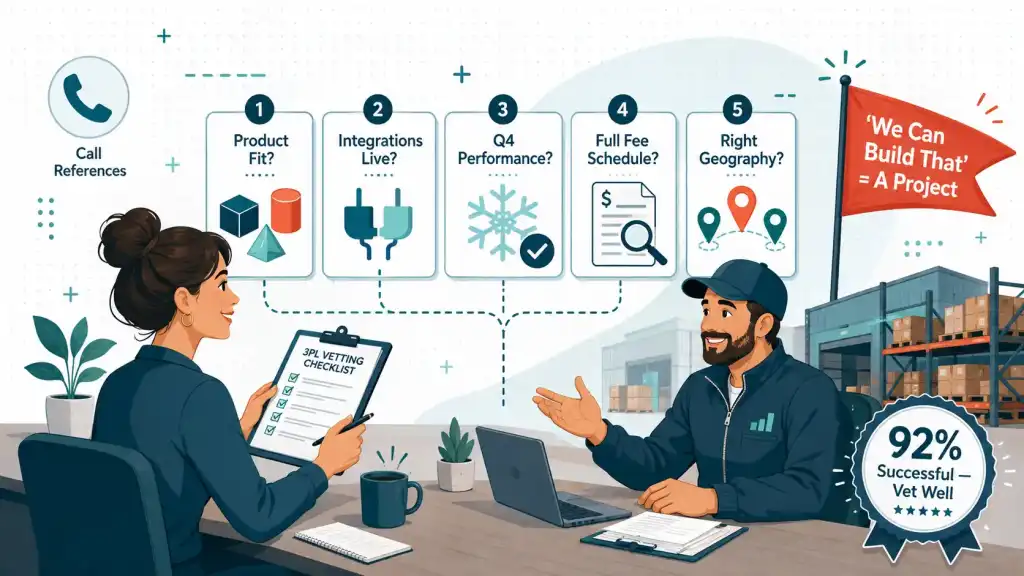
Match their specialty to your product. A 3PL brilliant at apparel may be clumsy with fragile goods or oversized items. Ask what percentage of their current clients ship products like yours.
Test their integrations before signing. Your store platform, marketplaces, and their warehouse software must talk fluently. ‘We can build that integration’ is a project, not a feature.
Interrogate peak-season performance. Ask for last Q4’s on-time ship rate and how they handle capacity crunches. Every 3PL is excellent in April; contracts are earned in November.
Get the full fee schedule in writing. Including the quiet ones: minimums, long-term storage, special handling, account fees. Surprise fees are the #1 source of 3PL breakups — and 92% of shippers report successful 3PL relationships, so the failures are usually a vetting problem, not an industry problem.
Check geography against your customers. Warehouses near your customer density cut both transit time and shipping zones. One well-placed location often beats two poorly placed ones.
The Bottom Line
So, what is a 3PL when you strip the jargon? It’s your logistics department, rented — warehousing, fulfillment, shipping, and returns run by specialists with infrastructure and carrier rates you couldn’t build alone at your size. The move makes sense when volume is steady, channels are multiplying, and your own hours have better uses than bubble wrap; it pays off when you vet for product fit, integration quality, peak performance, and a fee schedule with no plot twists.
If you’re weighing DIY vs 3PL vs FBA — or building the multi-channel setup that uses all three intelligently — that’s exactly the kind of operations-plus-marketing strategy I help brands design. Let’s map your fulfillment before your next growth spike does it for you.
Frequently Asked Questions
What is a 3PL in simple terms?
A third-party logistics provider — a company that stores your inventory and handles order fulfillment: receiving stock, warehousing it, picking and packing orders, shipping them at negotiated carrier rates, and processing returns, so you don’t run your own warehouse.
What’s the difference between a 3PL and a 4PL?
A 3PL physically handles warehousing and fulfillment. A 4PL sits above, coordinating multiple 3PLs, carriers, and customs brokers as a strategic manager. Brands shipping under ~50,000 orders monthly almost always need a 3PL; 4PLs serve complex enterprise supply chains.
How much does a 3PL cost?
Pricing is modular: receiving (per pallet/carton), storage (per pallet or cubic foot monthly), pick and pack (per order plus per item), pass-through shipping at negotiated rates, and extras like FBA prep (~$0.40–$1.50/unit). The meaningful metric is all-in cost per order versus your true DIY cost including labor and time.
When should a business switch to a 3PL?
Common thresholds: roughly 500+ orders a month or $500K–$1M in annual revenue, fulfillment consuming hours that growth work should get, multi-channel expansion needing one inventory pool, or shipping rates clearly worse than competitors’. If volume is tiny or the product changes weekly, DIY a bit longer.
Can a 3PL work together with Amazon FBA?
Yes — it’s a standard 2026 setup: the 3PL holds master inventory, preps and forwards optimized shipments into FBA (5+ fulfillment-center splits can eliminate Amazon’s inbound placement fee), and fulfills your website and other channels in branded packaging. Since Amazon ended its own prep services in January 2026, 3PL prep has become the default route.
How do I choose a good 3PL?
Vet for product-category fit, proven integrations with your platforms, documented peak-season (Q4) performance, a complete written fee schedule including minimums and special handling, and warehouse locations matching your customer geography. Ask for references from clients with similar products and volume.
If you’re also weighing Amazon’s own fulfillment costs against a 3PL, see our breakdown of Amazon FBA fees in 2026.
Further reading and data sources: www.trade.gov www.wto.org www.investopedia.com iccwbo.org