
One Page Business Plan: How to Write One That Actually Gets Used (Free Structure)
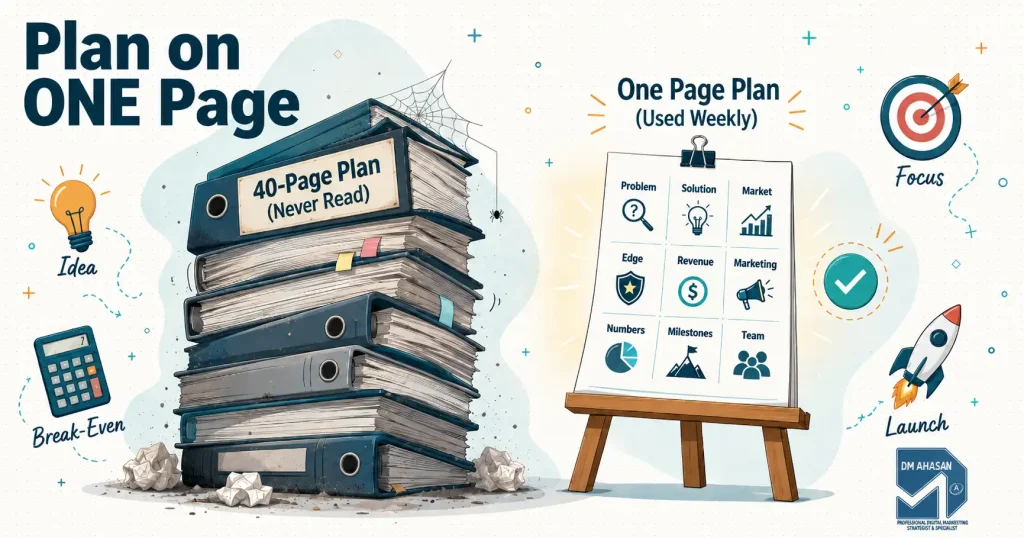
A one page business plan is exactly what it sounds like: your entire business — the problem, the customer, the money, the plan — condensed onto a single page you can actually read, update, and use, instead of a 40-page document that gets written once, admired briefly, and buried in a folder named ‘Final_v3_REAL_final.’
And before anyone dismisses the short format as lazy: the research is firmly on planning’s side. Entrepreneurs who write a formal plan are 16% more likely to build a viable business, planned businesses grow up to 30% faster, and startups with a plan secure funding at 78% versus 36% for those without one. The catch? None of those studies required the plan to be long. They required it to exist. One sharp page beats zero brilliant chapters, every single time.
What Is a One Page Business Plan?
A one page business plan is a condensed strategic document that captures the nine essentials of a business — problem, solution, market, competition, revenue model, marketing, numbers, milestones, and team — in a format short enough to review weekly and honest enough to expose weak thinking immediately.
That last part is the secret weapon. Vague ideas hide comfortably in long documents; there’s always another paragraph to bury the hand-waving in. On one page, a fuzzy answer to ‘how will you find customers?’ sits there in broad daylight, looking embarrassed. Brevity doesn’t just save time — it forces clarity.
As Mike Tyson famously put it: ‘Everyone has a plan until they get punched in the mouth.’ The one-page format accepts this reality. It’s not a prophecy — it’s a living document designed to be revised every time the market throws a punch, which it will, usually on a Monday.
Who Should Use a One Page Business Plan (And Who Shouldn’t)
Perfect for:
- First-time founders validating an idea before committing savings to it
- Freelancers and consultants who need direction more than documentation
- Small businesses and e-commerce sellers planning the next 12 months
- Existing companies testing a new product line or market
- Anyone whose current ‘business plan’ lives entirely in their head, where it cannot be argued with
Not enough for:
- Bank loan applications — most lenders still want full financial projections
- Formal investor due diligence — a one-pager opens the door; a full plan walks through it
- Regulated industries where detailed compliance documentation is required
Think of it this way: the one-pager is your strategy. The long plan, when needed, is your strategy plus paperwork.
The 9-Section Structure (Your Free Template)
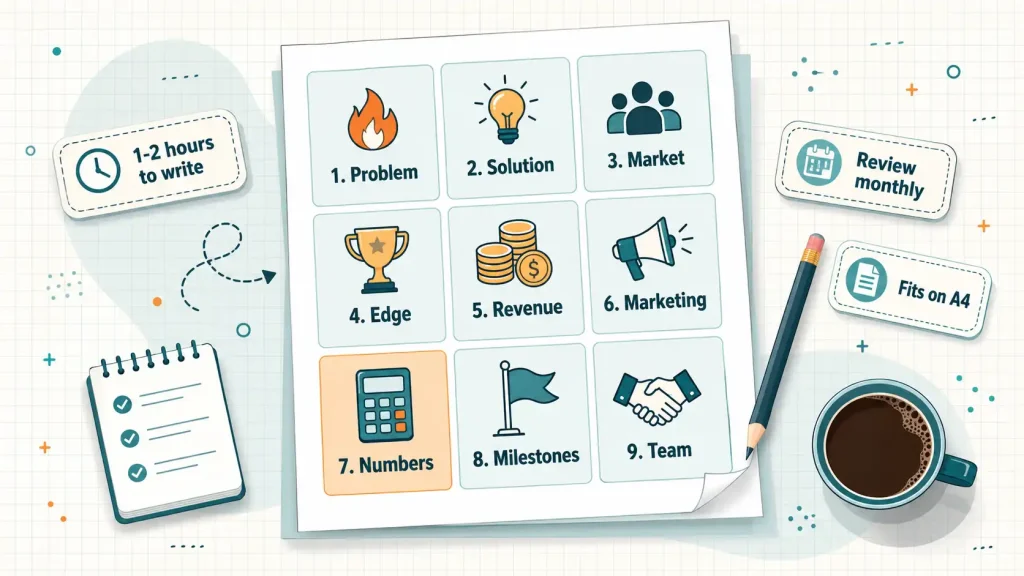
Here’s the exact structure I recommend. It fits on one A4 page with a 10-11pt font and honest margins — no cheating with 6pt text, that’s just a long plan in disguise:
| Section | The Question It Answers | Space Budget |
| 1. Problem | What pain, cost, or frustration do your customers have today? | 1–2 sentences |
| 2. Solution | What do you sell, and how does it fix that problem? | 1–2 sentences |
| 3. Target Market | Who exactly buys this — and roughly how many of them exist? | 2–3 lines |
| 4. Competition & Edge | Who else solves this, and why would customers pick you? | 2–3 lines |
| 5. Revenue Model | How does money actually come in — pricing, margins, repeat sales? | 2–3 lines |
| 6. Marketing Channels | Where will you find customers, realistically, in year one? | 2–3 lines |
| 7. Startup Costs & Numbers | What does it cost to start and run monthly — and your break-even point? | 3–4 key figures |
| 8. Milestones | What are the 3–5 checkpoints for the next 12 months? | 3–5 bullet dates |
| 9. Team & Ask | Who’s building this — and if you need funding, how much and for what? | 1–2 lines |
How to Fill It In: A Walkthrough With a Real Example
Let’s fill the skeleton with flesh. Imagine ‘DhakaDesk’ — a fictional startup selling ergonomic laptop stands to remote workers in South Asia:
1. Problem: “Remote workers in Bangladesh and India suffer neck and back pain from working hunched over laptops; imported ergonomic gear is expensive and takes weeks to arrive.”
2. Solution: “Locally manufactured bamboo laptop stands at one-third the price of imports, delivered in 3 days.”
3. Target Market: “Urban remote workers and freelancers aged 22–40 in Dhaka, Chattogram, and Kolkata — a growing segment of several million people, reachable through the platforms they already work on.”
4. Competition & Edge: “Imported brands (expensive, slow shipping) and generic plastic stands (flimsy). Our edge: local production = lower price, faster delivery, and a sustainability story imports can’t match.”
5. Revenue Model: “Direct-to-consumer sales at ৳1,800 per unit, ~55% gross margin; corporate bulk orders as a second stream from month 6.”
6. Marketing Channels: “Facebook and Instagram ads to remote-work interest groups, content marketing on desk setups, partnerships with coworking spaces. One channel mastered before adding the next.”
7. Startup Costs & Numbers: “৳4,50,000 initial (molds, first inventory batch, website); ৳60,000/month operating; break-even at ~95 units/month by month 5.”
8. Milestones: “Month 1: 50 pre-orders. Month 3: first production batch sold out. Month 6: first corporate order. Month 9: profitable month. Month 12: second product launched.”
9. Team & Ask: “Two co-founders (product + marketing). Not raising — bootstrapped; will revisit after month 12 numbers.”
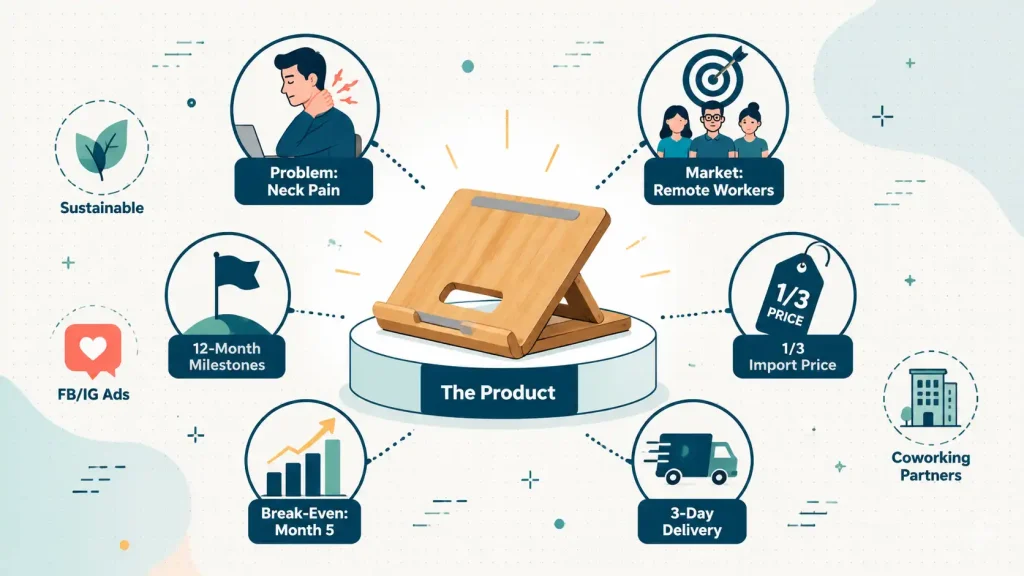
Notice what just happened: in nine short answers, you can already judge whether this business makes sense — and more importantly, so can the founder. That break-even number in section 7 will either survive contact with a calculator or it won’t. (Speaking of which — knowing the difference between cash flow and profit will save this founder from the classic trap of being ‘profitable’ and broke simultaneously. That’s a whole topic I cover separately.)
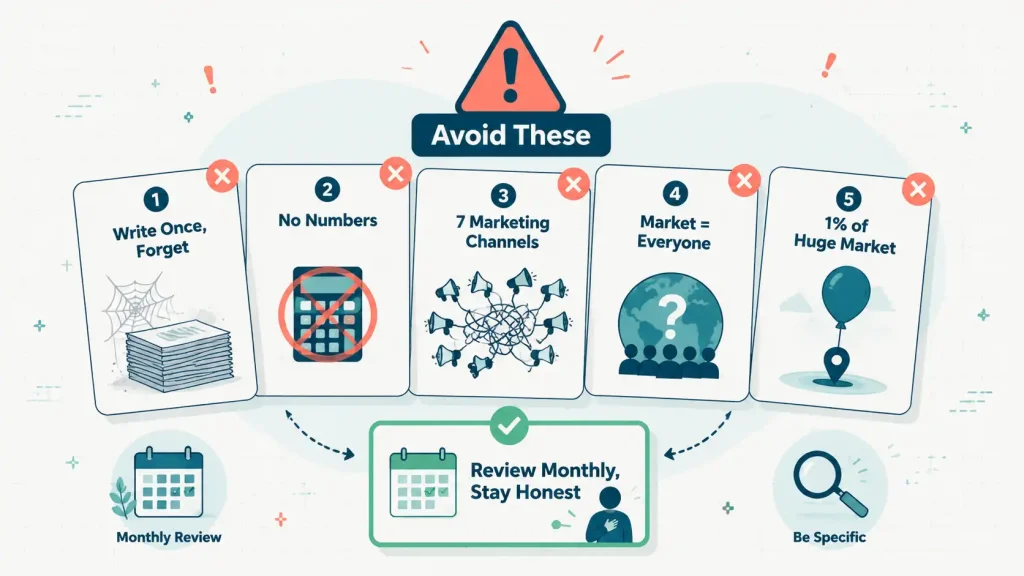
5 Mistakes That Ruin One Page Business Plans
- Writing it once and never touching it again. The one-pager’s superpower is being reviewable in five minutes — schedule a monthly date with it. It misses you.
- Skipping the numbers section because ‘it’s early.’ It’s never too early for break-even math; it’s only ever too late.
- Listing seven marketing channels. That’s not a strategy, that’s a wish list. Pick one or two and get specific — funnel thinking helps enormously here, and yes, I have a full guide on that too.
- Describing the market as ‘everyone.’ If everyone is your customer, no one is your marketing target, and your ad budget will confirm this expensively.
- Confusing optimism with projections. ‘We’ll capture 1% of a huge market’ has funded more disappointments than any sentence in business history.
The Bottom Line
A one page business plan won’t impress anyone with its weight — and that’s precisely the point. It exists to make you think clearly, act quickly, and revise honestly. Write it this week, pin it where you can see it, and update it monthly as reality reports in. When you eventually need the long version for a bank or investor, you’ll find it almost writes itself — because the thinking is already done.
And if you’d like an experienced second brain on the strategy itself — the market, the model, the marketing channels that’ll actually work for your business — that’s exactly what I do with founders and small businesses. Let’s pressure-test your page together.
Frequently Asked Questions
What is a one page business plan?
It’s a condensed business plan that fits your entire strategy — problem, solution, target market, competition, revenue model, marketing, key numbers, milestones, and team — onto a single page, designed to be reviewed and updated regularly rather than written once and forgotten.
Is a one page business plan enough to start a business?
For validating an idea, guiding your first year, and aligning a small team — yes, absolutely. For bank loans, formal investment due diligence, or regulated industries, you’ll eventually need a fuller document, but the one-pager makes that longer version far easier to write.
What should a one page business plan include?
Nine essentials: the problem, your solution, target market, competition and your edge, revenue model, marketing channels, startup costs with a break-even estimate, 12-month milestones, and the team (plus funding ask, if any).
How long should it take to write a one page business plan?
A focused first draft takes 1–2 hours. If it’s taking days, you’re likely researching to avoid deciding — write the draft with your current knowledge, then let the gaps tell you what to research.
What’s the difference between a one page business plan and a lean canvas?
They’re close cousins. The Lean Canvas is a specific nine-box visual grid popularized in the startup world; a one page business plan is the broader concept and can be a simple structured document. Same philosophy: clarity over length. Use whichever format you’ll actually maintain.
Do investors accept one page business plans?
As a first touch, yes — many investors prefer a crisp one-pager or short deck over an unsolicited 40-page plan. Statistically, startups with a written plan secure funding at roughly double the rate of those without one; the one-pager gets the conversation started, and deeper documents follow genuine interest.
How to Write a business plan by Young Entrepreneurs Forum
A one-page plan is just the starting point — once you know your business model, you still need a marketing funnel to turn strategy into customers, and a clear read on reducing acquisition costs if you’re SaaS. For a closer look at the format this structure is inspired by, see Lean Canvas, from its original creator. Want help turning your plan into a growth strategy? Explore our Brand & Growth Strategy service.
Sources
- How to Write a Business Plan — Young Entrepreneurs Forum (YouTube)
- Lean Canvas — Ash Maurya