
First-Party Data: The Ultimate Guide to Marketing’s Proven New Goldmine 2026
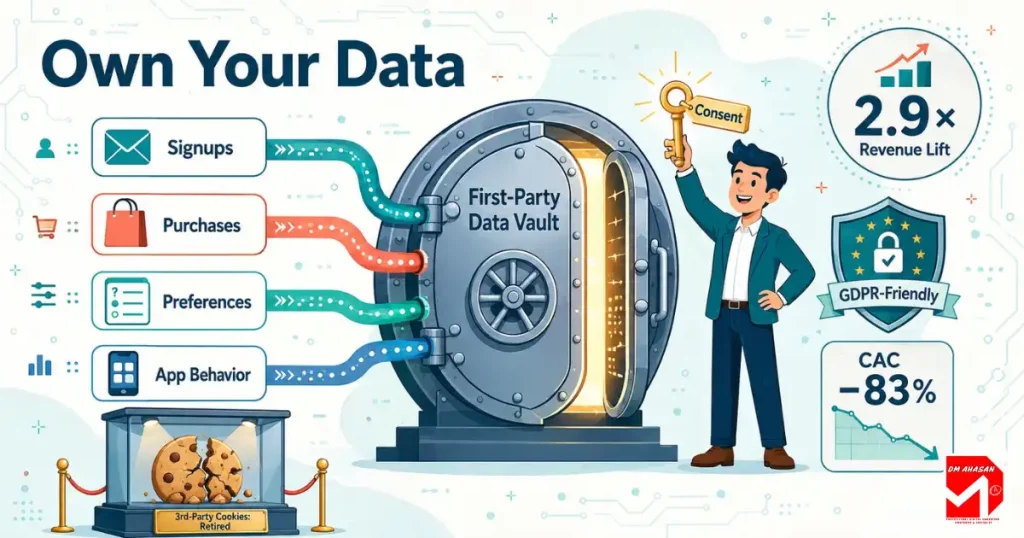
First-party data is the information customers give you directly — through your website, purchases, email signups, app usage, and loyalty programs — and in 2026 it has quietly become the most valuable asset in marketing: 84% of marketers now use it as a primary data source, brands built on it report customer-acquisition-cost improvements of up to 83%, and Google/BCG research found companies using first-party data effectively generate 2.9× the revenue lift of those relying on other sources. The era of renting your audience from tracking cookies is over; the era of owning your customer relationships is here — and it turns out ownership pays better.
This guide covers what first-party data actually is (and isn’t), why the cookieless shift made it non-negotiable, exactly how to start collecting it this month, and the unification problem that separates brands that talk about data from brands that profit from it.
First-Party Data: What It Is (and What It Isn’t)
First-party data is information you collect directly from your own audience through your own channels, with their consent: website behavior, purchase history, email engagement, app activity, survey answers, support conversations. It’s accurate (it came from the source), compliant (they gave it to you), and exclusive (competitors can’t buy it).
The family tree, for clarity:
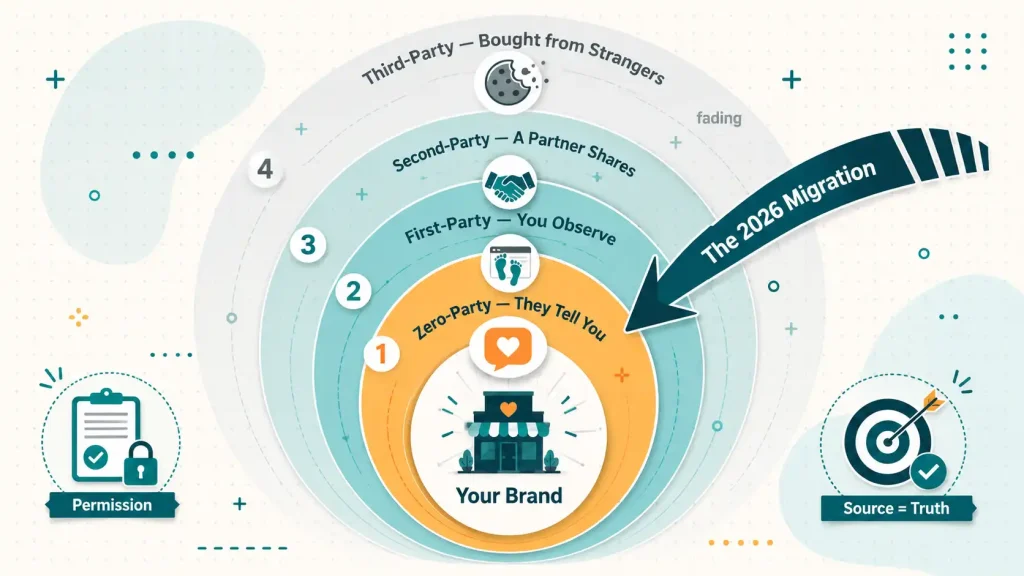
Third-party data built modern ad targeting — and it’s the layer collapsing. Which brings us to why everyone suddenly discovered religion about owning their data.
Why the Shift Became Unavoidable
- Privacy regulation grew teeth: GDPR fines have passed €7 billion cumulatively, and by January 2026 more than 19 US states had comprehensive privacy laws. ‘We’ll sort compliance later’ is now a budget line item with interest.
- The signals physically vanished: roughly 48% of global web traffic is already cookieless via Safari and Firefox protections, 67% of US adults actively disable tracking, and client-side pixels now miss 30–50% of conversions. The old measurement isn’t degrading politely — it’s gone in places.
- The industry voted with budgets: 71% of brands, agencies, and publishers are growing their first-party datasets — nearly double 2022’s 41% — and 75% of brands plan to reduce or drop third-party data entirely by end of 2026.
- And yet readiness lags badly: only ~15% of marketers described themselves as fully ready for the cookieless world, and just 31% are satisfied with their ability to unify customer data. Translation: the opportunity is still wide open for whoever does the unglamorous work.
How to Start Collecting First-Party Data (This Month, Not ‘Someday’)
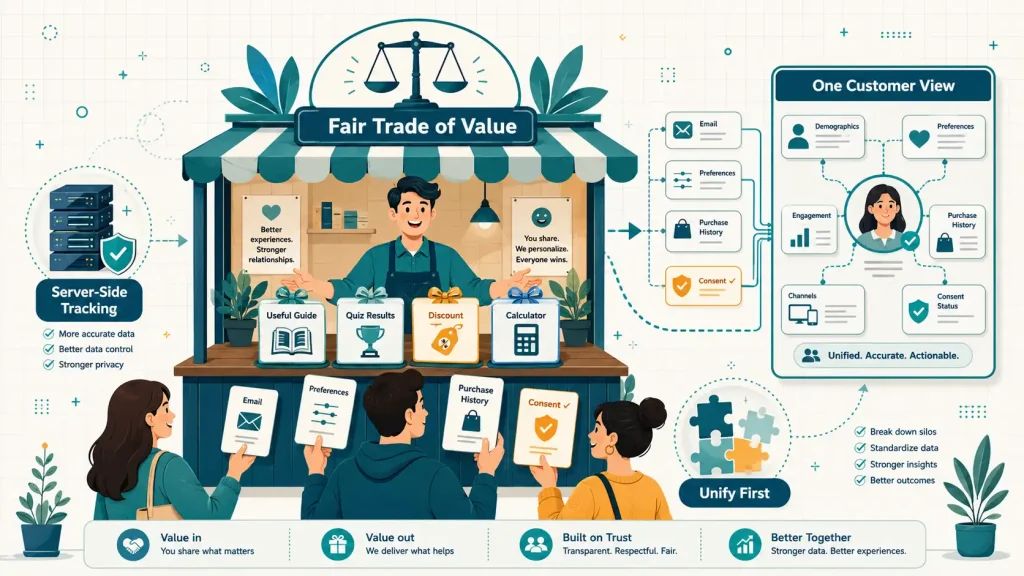
1. Make email your foundation. 63% of advertisers name email newsletters as their primary first-party collection channel — because an email address is a durable identifier plus a direct line. Offer genuine value for the signup: a useful guide, a discount, early access. ‘Subscribe to our newsletter’ with no reason attached is a donation request, not an exchange.
2. Trade value for information, visibly. Quizzes, calculators, configurators, and preference centers collect zero-party gold while actually helping the customer. A ‘find your ideal product’ quiz converts better than a form and teaches you what a form never could.
3. Instrument your owned channels properly. Server-side tracking and enhanced conversions recover much of what browser pixels now miss. If your analytics still relies entirely on client-side tags, you’re making decisions on 60–80% of the picture — with the missing slice biased in unhelpful ways.
4. Turn transactions into profiles. Purchase history is the highest-intent data you own. Connect it to email engagement and site behavior and you can segment by actual demonstrated interest instead of demographic guesswork. This is the marketing funnel dream — knowing genuinely who’s at which stage — finally running on data you own.
5. Unify before you multiply. The satisfaction gap (84% use first-party data; 31% can unify it) lives here. Whether via a proper CDP — a market heading toward $10.3 billion in 2026 — or a disciplined smaller stack, one connected customer view beats five disconnected databases every single time. Collect less if needed; connect everything you collect.
6. Make consent a feature, not fine print. Clear language about what you collect and what customers get in return builds the trust that makes people share more. Privacy-first isn’t the tax on modern marketing; done honestly, it’s the pitch.
What First-Party Data Actually Wins You
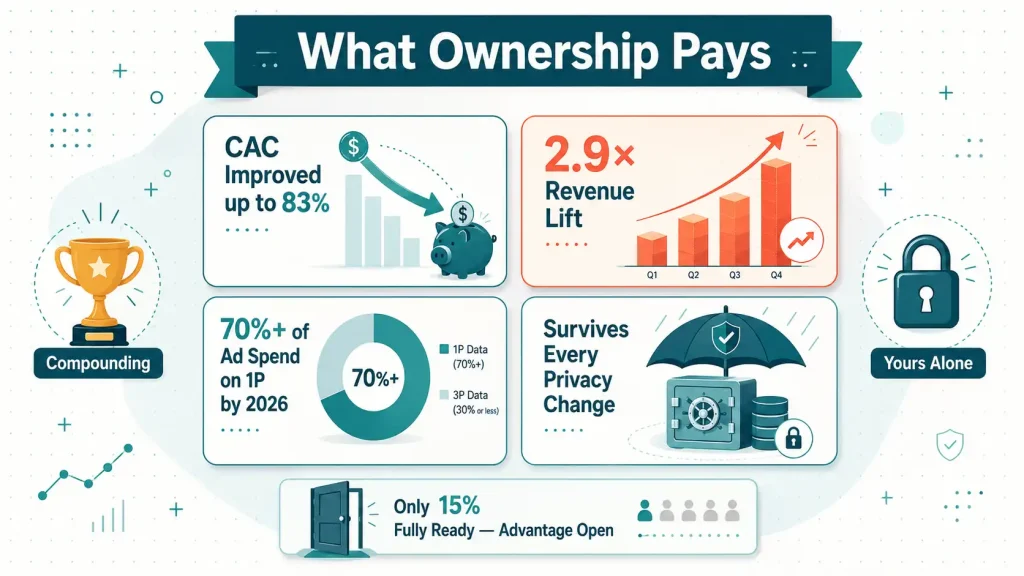
- Cheaper acquisition: Forrester-cited research puts CAC improvement at up to 83% and conversion improvement at 73% for brands with strong first-party behavioral data — because targeting people you actually know beats renting guesses.
- Compounding revenue: the Google/BCG 2.9× revenue-lift finding isn’t magic; it’s the boring miracle of relevance repeated across every email, ad, and page.
- Algorithm independence: when 70%+ of digital ad spend is expected to run on first-party strategies by end of 2026, the brands feeding platforms their own high-quality signals get better results from the same budgets.
- Resilience against every future privacy change: data customers gave you directly survives every cookie deprecation, tracking prevention update, and regulation still to come. It’s the only marketing asset with that warranty.
The Bottom Line
First-party data is the rare marketing shift where the compliant path and the profitable path are the same road: collect information directly, with consent, in exchange for real value — then unify it and let relevance do the compounding. The statistics are lopsided (2.9× revenue lift, 83% CAC improvement, 71% of the industry building datasets), but the readiness gap is just as lopsided, which means the advantage still belongs to whoever starts the unglamorous collection-and-unification work now instead of admiring it in conference decks.
Start with one email-capture offer worth signing up for, one quiz or calculator, and one honest look at whether your data connects into a single customer view. And if you’d like help designing that system — the offers, the flows, and the strategy that turns owned data into owned growth — that’s exactly what I build with brands. Let’s talk.
Frequently Asked Questions
What is first-party data in simple terms?
It’s information your customers and visitors give you directly through your own channels — website behavior, purchases, email engagement, app usage, surveys — collected with their consent. It’s the most accurate and legally durable data a business can own.
What’s the difference between first-party and zero-party data?
Zero-party data is information customers intentionally volunteer (quiz answers, stated preferences); first-party data is what you observe on your own channels (purchases, clicks, visits). They work best together: zero-party tells you what people say they want, first-party shows what they actually do.
Why is first-party data so important in 2026?
Because the alternatives collapsed: third-party cookies are blocked across large swaths of the web, privacy laws now cover most major markets, and client-side tracking misses 30–50% of conversions. Meanwhile first-party approaches demonstrably outperform — up to 83% better CAC and a 2.9× revenue lift in Google/BCG research.
How do small businesses collect first-party data without expensive tools?
Start simple: an email list with a genuinely valuable signup offer, a quiz or calculator that helps customers while teaching you their preferences, purchase-history segmentation in whatever e-commerce platform you already use, and clear consent language. Sophistication can come later; ownership starts now.
Do I need a CDP (Customer Data Platform)?
Eventually, maybe — the CDP market is heading toward $10.3 billion in 2026 for a reason — but only after you have data worth unifying. Many small and mid-size brands do fine connecting their e-commerce, email, and analytics tools first. The principle matters more than the product: one unified customer view.
Is first-party data GDPR compliant?
It’s the most compliance-friendly data category — collected directly, with consent, for stated purposes — but compliance still depends on how you handle it: clear consent, honest privacy notices, secure storage, and honoring deletion requests. Owning the data means owning the responsibility too.
First-party data is only useful if it feeds a working funnel — see our guide on building a marketing funnel and how brands cut customer acquisition costs using this kind of data.
Further reading and data sources: moz.com contentmarketinginstitute.com